

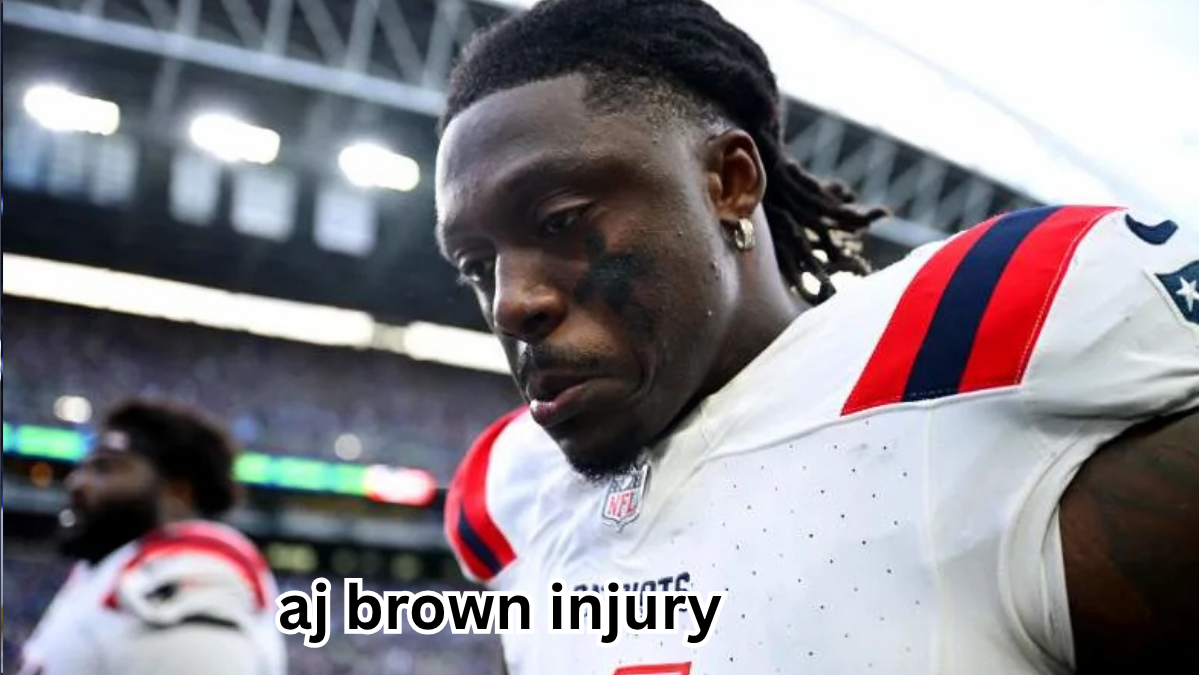
The latest aj brown injury news has quickly become one of the biggest storylines surrounding the New England Patriots after their 2026 season opener against the Seattle Seahawks. Brown left the game in the third quarter after a Seahawks defender landed on the outside of his right ankle, forcing the veteran wide receiver to leave the field and receive medical attention. The Patriots later lost 13-10, turning an already difficult opening night into a more concerning situation for one of their most important offensive players.
The initial information is concerning but does not yet establish a definitive long-term absence. Brown’s X-rays showed no fracture, while an MRI is scheduled to determine the extent of the damage. Reports indicate that the injury is believed to be a high-ankle sprain, a type of injury that can affect a receiver’s ability to accelerate, cut, plant, absorb contact, and maintain balance through routes. Because Brown’s game depends heavily on explosive movement and physicality, the final diagnosis will be particularly important.
The situation also deserves context because Brown entered the 2026 season with a new team, a major role in the Patriots offense, and a long history of elite production. New England acquired him from Philadelphia in June 2026, reuniting him with head coach Mike Vrabel, who had previously coached Brown during his first three NFL seasons with Tennessee. The transition was supposed to give the Patriots another premier weapon for quarterback Drake Maye. Instead, Brown’s debut ended prematurely.
Latest Injury Update and What Happened Against Seattle
The current aj brown injury occurred during New England’s season-opening matchup with Seattle. Brown was targeted on a third-down play early in the second half when Seahawks cornerback Nehemiah Pritchett defended the pass. Pritchett’s knee came down on the outside of Brown’s ankle, causing the ankle to twist inward. Brown immediately needed attention from the Patriots’ medical staff and removed his cleat before entering the medical tent.
Before leaving, Brown had recorded three receptions for 26 yards and had been one of the more noticeable pieces of New England’s passing attack. He also drew a significant defensive pass interference penalty that helped create an important offensive opportunity. His limited statistical production did not tell the entire story because he had already been heavily involved in the Patriots’ offensive plans. Reports noted that he had been on the field for 31 of New England’s first 35 offensive plays, illustrating how central he was to the game plan.
Brown was initially listed as questionable to return, but he ultimately did not come back onto the field. He was later seen leaving the locker room in a walking boot, adding another visual sign that the Patriots were taking the injury seriously. Head coach Mike Vrabel did not provide a definitive postgame diagnosis, leaving the MRI as the next major step in determining the severity of the problem.
The most important positive development so far is the absence of a fracture on the initial X-rays. That does not automatically mean Brown will be available soon, because ankle sprains can vary dramatically in severity. A mild sprain may heal relatively quickly, while a high-ankle sprain involving the ligaments above the ankle joint can require a significantly longer recovery period. The MRI should provide much more useful information about the affected structures and the expected rehabilitation process.
Why a High-Ankle Sprain Matters for a Wide Receiver
A high-ankle sprain is different from the more familiar lateral ankle sprain that affects the ligaments on the outside of the ankle. A high-ankle injury generally involves the syndesmotic ligaments that connect the lower leg bones around the ankle. Those structures help maintain stability when the foot and lower leg experience rotational forces, which makes this type of injury particularly relevant to athletes who repeatedly plant, cut, accelerate, and absorb contact.
For a wide receiver, those movements happen on nearly every route. A receiver can technically walk while still having significant difficulty running at full speed, changing direction sharply, or exploding out of a break. That is why a player may appear capable of moving around while still being unavailable for football activities. The demands of an NFL route are much higher than ordinary daily movement, and returning too early can increase the risk of aggravating the injury.
Brown’s physical style makes the issue especially important. He is not simply a player who runs straight down the field and catches passes. His effectiveness comes from a combination of acceleration, strength, route manipulation, contested-catch ability, contact balance, and the ability to create separation against physical coverage. Any limitation in ankle stability can affect several parts of that skill set simultaneously.
The phrase “high-ankle sprain” also should not automatically be interpreted as a season-ending diagnosis. Recovery depends on the grade of the sprain, the structures involved, swelling, pain, stability, response to rehabilitation, and whether the athlete can safely perform football-specific movements. The Patriots will have much more clarity after the MRI and subsequent evaluations.
Understanding the Initial Medical Picture
The aj brown injury should currently be viewed as an evolving medical situation rather than a completed diagnosis. The available reports establish that Brown suffered a right ankle injury, that the injury occurred after contact with Pritchett, that he did not return to the game, and that X-rays showed no fracture. Reports also indicate that an MRI is planned because the medical team needs more information before establishing a recovery timeline.
That distinction matters when interpreting reports circulating online. Early injury news often moves faster than medical certainty. A player can be described as having a suspected high-ankle sprain before imaging confirms the exact ligament damage. Similarly, a player can leave in a boot without that boot necessarily indicating a severe tear. Medical teams frequently use boots as a precaution because they restrict movement and provide protection while the injury is being evaluated.
The next major information will likely involve the MRI results, the Patriots’ practice reports, and Brown’s ability to begin football-related activity. Practice participation can offer clues about progress, but it still does not provide the same level of detail as an actual medical evaluation. A player listed as limited may be progressing well, while another player with a similar designation may still be far from game readiness.
Another important factor is the Patriots’ schedule. New England has an extended period before its next game against the Pittsburgh Steelers on September 20, giving Brown additional recovery time compared with a standard seven-day turnaround. That extra time could become valuable if the injury is moderate rather than severe.
A.J. Brown’s Role in the Patriots Offense
Brown arrived in New England with expectations that went far beyond simply adding another receiver to the roster. He was acquired because he can change defensive structures, win one-on-one matchups, create explosive plays, and force opponents to devote significant attention to the passing game. His presence can influence the offense even when he does not receive the football.
The Patriots’ offense also benefits from Brown’s ability to function as both a vertical threat and a possession receiver. He can win downfield, attack intermediate zones, use his frame against smaller defensive backs, and create yards after the catch. That versatility gives offensive coaches flexibility when constructing weekly game plans.
For quarterback Drake Maye, having a receiver with Brown’s profile can simplify certain aspects of the passing game. Defenses have to respect Brown’s ability to win outside, which can create room for other receivers, tight ends, and running backs. When Brown commands safety help, another player may receive a more favorable matchup. When defenses play him with a single defender, the quarterback can take advantage of a potential mismatch.
That is why the Patriots’ concern extends beyond Brown’s individual statistics. The team did not simply lose three catches and 26 yards when he left the Seattle game. It lost one of the players capable of shaping defensive attention before the ball is even snapped. His availability can therefore influence the performance of the entire offense.
Brown’s Career Production Before the Injury
Brown’s career numbers help explain why his availability has become such a major story. According to NFL statistics, he entered the 2026 season with more than 8,000 receiving yards and 56 receiving touchdowns over his career. Through his first game with New England, his career totals had reached 527 receptions for 8,055 yards and 56 touchdowns across 106 games.
His production has been remarkably consistent across different offensive environments. Brown recorded 1,051 yards as a rookie with Tennessee in 2019, followed that with 1,075 yards in 2020, and then produced 869 yards in 13 games during the 2021 season. Philadelphia subsequently acquired him, and he immediately became one of the central pieces of its offense.
His first Eagles season in 2022 was especially impressive. Brown finished with 88 receptions for 1,496 yards and 11 touchdowns, averaging 17 yards per reception. That performance established the foundation for several seasons of elite production in Philadelphia and helped demonstrate that his success was not limited to the Tennessee system.
In 2023, Brown raised his volume even further, catching 106 passes for 1,456 yards and seven touchdowns. He followed that with 67 receptions for 1,079 yards and seven touchdowns in 13 games during 2024. In 2025, his final Philadelphia season, he recorded 78 receptions for 1,003 yards and seven touchdowns in 15 games.
The consistency is particularly notable because Brown’s value is not built on short-area volume alone. His career receiving average has remained around 15.3 yards per reception, reflecting his ability to generate substantial gains. Among players with at least 250 receptions since 2019, the Patriots say he ranks third in yards per reception, fourth in receiving yards, and fourth in receiving touchdowns.
The 2026 Trade That Changed the Context
Brown entered New England after a significant offseason transition. In June 2026, Philadelphia traded him to the Patriots for a 2028 first-round pick and a 2027 fifth-round pick. The deal reunited Brown with Vrabel, who had been involved in the beginning of Brown’s NFL career in Tennessee.
The trade represented a major change for both franchises. Philadelphia moved forward with a redesigned receiver group while New England acquired an established star for an offense that had ambitions of competing at the highest level. Brown’s contract also made the move financially significant, with his deal extending through 2029 and averaging $32 million annually according to reporting surrounding the trade.
Brown’s familiarity with Vrabel was another major storyline. Vrabel was Tennessee’s head coach when Brown entered the league, and Brown became one of the most productive receivers from that era. Returning to a familiar coaching relationship can help a player adjust to a new organization, although the offensive terminology, quarterback relationship, teammates, and weekly responsibilities still require adaptation.
That makes the timing of the ankle injury especially unfortunate. Brown had only just begun his Patriots chapter. Instead of building chemistry over the opening weeks of the season, he now faces an uncertain recovery period immediately after his debut.
Brown’s History With Hamstring Injuries
Although the current issue involves Brown’s right ankle, his injury history has also included hamstring problems. This distinction is important because not every absence involving Brown has had the same cause or significance.
One of the clearest examples occurred in 2024. Brown suffered a hamstring injury during practice ahead of Philadelphia’s Week 2 game against Atlanta and was ruled out. He subsequently missed the next several games before returning against Cleveland. When he returned, Brown said he felt fully healthy and explained that he had learned an important lesson about balancing his workload.
The Eagles’ official report from October 2024 noted that Brown had missed three games with the hamstring issue before returning. In his only game before that injury, he had recorded 119 yards and a touchdown on five receptions against Green Bay. His return therefore represented a significant boost for Philadelphia’s offense.
A similar concern emerged in 2025 when Brown missed Philadelphia’s Week 8 game against the Giants with another hamstring problem. He had played the first seven games of that season before being ruled out after missing the week’s practices.
Those episodes show why NFL teams generally take soft-tissue injuries seriously. Hamstrings are heavily involved in sprinting and explosive movement, and returning before full strength and flexibility are restored can create additional problems. Brown’s history does not determine the outcome of his current ankle issue, but it does explain why the Patriots are likely to take a measured approach rather than rushing him back.
How the Current Injury Differs From Previous Problems
The aj brown injury in 2026 is structurally different from the hamstring problems Brown experienced in Philadelphia. That does not make it automatically more serious or less serious, but it changes the rehabilitation process and the football movements that medical staff will monitor.
A hamstring issue primarily affects the muscles and tendons along the back of the thigh, while a high-ankle sprain involves stabilizing structures around the lower leg and ankle. The performance demands overlap because both areas are important for acceleration, but the rehabilitation tests are different.
For Brown, the ankle will need to tolerate planting and cutting before he can be considered ready for full-speed route running. A receiver can look comfortable jogging in a straight line but still experience discomfort when making a hard 45-degree or 90-degree cut. Football-specific movement is therefore one of the most important parts of the eventual return-to-play process.
The injury mechanism also matters. Brown’s ankle was twisted when another player’s knee landed on it. That is a direct traumatic event rather than an overuse problem. The MRI should help determine whether the force produced a mild sprain, a more significant syndesmotic injury, or another form of tissue damage.
Until that information is available, predictions about the exact number of games Brown might miss should be treated carefully. The safest assessment is that the Patriots will evaluate the imaging, monitor his response, and gradually increase his workload rather than commit to a specific return date before the medical picture becomes clearer.
A.J. Brown Injury Timeline and Key Dates
| Date or Period | Development | Why It Matters |
|---|---|---|
| June 2026 | Traded from Philadelphia to New England | Brown begins a new chapter with the Patriots |
| September 9, 2026 | Injured right ankle against Seattle | First major injury of his Patriots tenure |
| September 9, 2026 | X-rays show no fracture | Positive initial finding |
| September 9, 2026 | Did not return to game | Suggests medical staff considered continued play unsafe |
| September 10, 2026 | High-ankle sprain reported as suspected | Raises concern about recovery length |
| September 10, 2026 | MRI planned | Imaging expected to clarify severity |
| September 20, 2026 | Patriots scheduled to face Pittsburgh | Extra recovery time may help Brown’s availability |
The timeline illustrates why the situation remains fluid. The initial injury happened on September 9, while the more specific high-ankle sprain reporting emerged the following day. The MRI therefore represents an important checkpoint rather than merely a formality.
The schedule could also influence how the Patriots manage the situation. New England’s next game is against Pittsburgh on September 20, giving Brown more recovery time than he would have if the Patriots were playing again within a few days. That does not guarantee availability, but additional days can be valuable for swelling reduction, mobility work, strength testing, and gradual football activity.
What the MRI Could Reveal
An MRI is useful because it can provide a much more detailed look at soft tissues than an X-ray. An X-ray is excellent for identifying many fractures, which explains why the negative result is encouraging, but it does not provide the same level of information about ligament damage.
For a suspected high-ankle sprain, medical professionals will want to understand which syndesmotic structures are affected and how severe the damage is. The stability of the ankle joint and the athlete’s ability to tolerate loading are also important factors in determining treatment.
The results can help establish whether Brown is dealing with a relatively mild injury that can be managed conservatively or something more significant that requires a longer rehabilitation program. In some cases, high-ankle sprains can linger because the structures involved are repeatedly stressed by running and cutting.
That is why the Patriots should not be judged solely by whether Brown practices during the next week. The goal is not simply to get him back onto the field as soon as possible. The goal is to get him back when he can perform at NFL speed without significantly increasing the risk of another injury.
Potential Recovery Timeline
Recovery timelines for ankle sprains are highly variable, and a suspected high-ankle sprain cannot be assigned a reliable timetable until the severity is established. Mild injuries can sometimes allow athletes to return relatively quickly, while more significant syndesmotic injuries can require several weeks or longer.
The location of the injury matters because high-ankle sprains tend to be stressed by rotational movements. Wide receivers are constantly asking the lower leg and ankle to absorb force while changing direction. Brown would therefore need to demonstrate more than basic mobility before returning to game action.
The Patriots also have a strong incentive to think beyond one game. Brown’s contract and role make him a major long-term investment, and the team’s offensive ambitions extend well beyond the opening week. Taking a conservative approach early could be preferable to creating a cycle of setbacks that affects a larger portion of the season.
The most meaningful signs of progress will likely include reduced swelling, improved range of motion, strength in the injured leg, ability to accelerate, ability to cut, and eventually full participation in football-specific drills. Only after those steps are completed can the team confidently determine whether Brown is ready for contact and game speed.
Fantasy Football Impact
The aj brown injury is also a major fantasy football concern because Brown entered the season as a high-value wide receiver. His target share, red-zone role, explosive-play ability, and established relationship with NFL-caliber quarterbacks have traditionally made him an important fantasy asset.
The immediate fantasy question is not simply whether Brown misses one game. The bigger concern is how the injury might affect his practice participation and workload over multiple weeks. A receiver returning from an ankle problem may initially have restrictions on routes, snaps, or certain types of movement even after being medically cleared to play.
Fantasy managers should therefore pay attention to practice reports rather than relying only on the official game designation. Limited participation can sometimes indicate a player is progressing toward a return, while a series of missed practices may suggest the rehabilitation process is taking longer.
There is also a difference between being active and being fully healthy. Brown has historically been capable of producing big numbers, but fantasy managers should consider the possibility of a reduced workload if he returns before reaching his normal movement capacity. The first game back may not immediately resemble his typical snap or target volume.
Impact on Drake Maye
Brown’s absence would place additional pressure on Drake Maye and the Patriots’ supporting receivers. The value of a premier outside receiver is particularly noticeable when defenses can devote more attention to the remaining options.
Maye can still operate an effective offense without Brown, but defensive coordinators gain greater freedom when one of the primary threats is unavailable. Safeties may be able to rotate toward other receivers, cornerbacks can play more aggressively, and defensive game plans can become more concentrated.
The Patriots’ depth therefore becomes important. Mack Hollins and Kyle Williams were among the players who helped fill the receiving workload after Brown left the Seattle game. The team will likely need contributions from multiple players if Brown is unavailable for an extended stretch.
Tight ends and running backs can also become more important in such circumstances. Shorter throws can help an offense maintain efficiency while the passing game adjusts, although replacing Brown’s ability to create explosive plays is much harder. The Patriots will likely need a combination of scheme adjustments and individual production to compensate.
Impact on the Patriots’ Offensive Strategy
A healthy Brown gives the Patriots the ability to create offensive formations that force defenses to account for him before the snap. His presence can stretch coverage horizontally and vertically, opening opportunities for other players.
Without him, offensive coordinators may rely more heavily on motion, bunch formations, play-action concepts, crossing routes, and formations designed to create free releases. These strategies can reduce the amount of press coverage younger receivers face and help quarterbacks identify defensive intentions.
The Patriots can also adjust their route distribution. If Brown misses time, more intermediate targets may go toward other receivers, while tight ends can become more involved in the middle of the field. Running backs may see more checkdowns and screen opportunities as the offense looks for high-percentage completions.
The challenge is maintaining explosiveness. Brown’s ability to turn an ordinary pass into a major gain is difficult to duplicate through scheme alone. The Patriots may therefore need to manufacture explosive opportunities rather than simply redistribute his targets.
What Brown’s Return Could Look Like
When Brown eventually returns, the Patriots may not immediately use him in exactly the same way they did before the injury. Coaches and medical personnel could manage his workload, especially if he has not yet completed a long stretch of full-speed practice.
A gradual return might begin with individual drills, followed by route work, then controlled team periods, and eventually full-contact practice. The purpose is to determine whether the ankle tolerates increasing levels of stress without renewed pain or swelling.
Route selection could also matter. Straight-line routes may be easier early in the process than routes requiring sudden breaks. A receiver returning from an ankle injury might initially receive fewer snaps on plays that require repeated sharp cuts.
That does not necessarily mean Brown would be ineffective. Elite receivers can remain valuable on reduced workloads because their ability to draw defensive attention remains intact. However, his fantasy and real-world statistical ceiling could be temporarily lower until the Patriots are confident that he has regained full explosiveness.
Brown’s 2025 Season Provides Useful Context
Brown finished his final Philadelphia season in 2025 with 78 receptions for 1,003 yards and seven touchdowns over 15 games. Those numbers represented his fourth consecutive season with at least 1,000 receiving yards, according to the Patriots’ career review.
That consistency is one reason the Patriots viewed him as such a valuable acquisition. Brown was not coming to New England as a declining veteran who needed to reinvent himself. He was still producing at a high level and remained capable of serving as a focal point of a modern passing offense.
His 2024 season also demonstrates his ability to maintain efficiency despite missing games. Brown finished that campaign with 67 receptions for 1,079 yards and seven touchdowns in 13 appearances. His average of 16.1 yards per catch showed that his big-play ability remained a major part of his profile.
The current ankle issue therefore represents a disruption to an established pattern of production rather than evidence that Brown’s career had already entered a major decline. At 29, he remains an important veteran player, and the Patriots will want to protect the long-term value of that investment.
How His Playing Style Affects the Injury Question
Brown’s playing style is one of the reasons his ankle health deserves close attention. He is a powerful receiver who combines size and acceleration, frequently using his physical strength to defeat defenders and gain yards after contact.
That style requires confidence in the lower body. A receiver who hesitates while planting because he is protecting an injured ankle can lose the split-second advantage needed to create separation. Even a small limitation can affect route timing between the quarterback and receiver.
Brown’s ability to break tackles is another consideration. He often finishes plays through contact rather than simply stepping out of bounds. Returning before the ankle is ready for those collisions could be risky because the player needs confidence that the joint can withstand unexpected forces.
For that reason, a successful rehabilitation program should ultimately reproduce the unpredictable nature of football. Running routes in controlled conditions is only part of the process. Brown will need to demonstrate that he can plant, cut, accelerate, absorb contact, and react instinctively without protecting the injured side.
Previous Hamstring Lessons Could Influence the Approach
Brown’s experience with hamstring injuries has already given him firsthand knowledge of how difficult it can be to manage a return to full football activity. His comments after returning from the 2024 hamstring problem showed an awareness that sometimes physical workload needs to be balanced against the desire to keep pushing.
That lesson may be useful now. A veteran player with Brown’s experience understands that missing a game or two can be preferable to turning a manageable injury into a prolonged problem. The Patriots also have a strong incentive to prioritize his long-term availability.
The rehabilitation process may therefore emphasize controlled progression rather than simply testing whether Brown can tolerate pain. Modern NFL teams have extensive sports-science resources, and decisions can incorporate strength measurements, movement analysis, medical imaging, practice response, and player feedback.
The most important factor is that Brown and the Patriots reach the same conclusion about readiness. A player can feel eager to return while medical staff remain concerned about reinjury risk. Successful return-to-play decisions require both competitive ambition and disciplined medical judgment.
The Psychological Side of Returning From an Injury
Physical rehabilitation receives most of the attention, but confidence also matters. A receiver returning from an ankle injury may subconsciously hesitate during the first few sharp cuts, particularly if the original injury happened during a sudden twisting motion.
That hesitation can affect performance even when the ankle is structurally healed. Football players depend on instinct, and a fraction of a second spent thinking about whether an ankle will hold can alter a route.
Practice is therefore important not only for physical conditioning but also for rebuilding confidence. Repeated successful movements allow a player to trust the injured area again. That process can take time even after medical clearance.
Brown’s experience and competitive personality should help, but veteran status does not eliminate the psychological component. Every athlete responds differently to injury, and the goal is to ensure that physical readiness and mental confidence return together.
What Patriots Fans Should Watch Next
The next major development in the aj brown injury story should be the MRI findings and the first official updates from the Patriots. Those details will provide a better indication of whether Brown is dealing with a short-term ankle sprain or a more significant syndesmotic problem.
Practice participation will then become an important indicator. If Brown begins with individual work and gradually advances, that would suggest the rehabilitation process is moving forward. If he remains absent from practice or experiences setbacks, the timeline could become longer.
Fans should also watch how the Patriots describe his status. Terms such as “limited,” “progressing,” “working on the side,” and “day-to-day” can provide clues, although they should not be treated as precise medical measurements.
Most importantly, the team will eventually need to determine whether Brown can perform football movements at full speed. His ability to walk without pain is encouraging but insufficient. His ability to run a complete route tree, plant aggressively, and withstand contact will matter much more.
Why the Patriots Have Reason to Be Patient
New England’s investment in Brown makes patience logical. The team gave up a future first-round selection to acquire him, and his contract keeps him under control for multiple seasons. The goal is therefore not simply to maximize his availability in Week 2.
A premature return could create a larger problem that affects several weeks or months. High-ankle sprains can be stubborn when repeatedly stressed, and wide receiver is a position where constant cutting places substantial demands on the lower body.
The Patriots also have other offensive players who can absorb opportunities in the short term. While none can fully replicate Brown, a combination of receivers, tight ends, and backs can keep the offense functioning while he recovers.
That depth gives New England a reason to think long term. If Brown needs additional recovery time, the Patriots can adjust their offense temporarily rather than risking a setback for a player they expect to be a central part of their attack for years.
The Broader Significance of the Injury
The current aj brown injury story is bigger than one player’s Week 1 statistics. Brown represents a significant part of New England’s offensive identity, and his health could influence how the Patriots approach the opening portion of the season.
It also demonstrates how quickly an NFL season can change. A player can spend an entire offseason preparing for a new opportunity, take the field healthy, and then suffer a significant injury on a single play. The unpredictable nature of football makes roster depth and injury management essential.
For Brown personally, the injury comes at a transitional point in his career. He moved from Tennessee to Philadelphia earlier in his career, became a Super Bowl champion with the Eagles, and then moved again to New England in 2026. Each transition required adjustment, and this latest setback arrives just as he begins another chapter.
The encouraging part is that initial X-rays did not reveal a fracture. The uncertain part is the condition of the ankle’s soft tissues. Those two facts can coexist, which is why the MRI and subsequent rehabilitation reports are so important.
A.J. Brown’s Legacy Remains Strong
Regardless of how long Brown is sidelined, his career résumé already establishes him as one of the most productive receivers of his generation. He has earned three Pro Bowl selections, three second-team All-Pro honors from 2022 through 2024, and a Super Bowl championship with Philadelphia.
His career numbers also show remarkable consistency. Through his first game with New England, he had accumulated 527 receptions, 8,055 receiving yards, and 56 receiving touchdowns. His career average of 15.3 yards per reception underscores his reputation as a receiver capable of changing games with explosive plays.
The Patriots did not acquire Brown because of what he might have been several years ago. They acquired him because of what he had continued to be: a productive, physical, explosive receiver capable of attracting defensive attention and making difficult plays.
One injury does not erase that body of work. It simply creates a temporary uncertainty around his availability.
What This Means for the Rest of the Season
The ultimate importance of the aj brown injury will depend on its severity and how Brown responds to treatment. If the MRI reveals a relatively mild sprain, he could potentially return after a limited absence and gradually resume his normal role.
If the injury is more significant, the Patriots may have to prepare for a longer stretch without their star receiver. In that scenario, the offensive adjustments discussed earlier would become much more important, particularly for Drake Maye and the players moving into expanded roles.
The Patriots’ ability to manage this period will also depend on how effectively they create explosive plays without Brown. A team can survive the absence of a star more easily when the offensive system creates opportunities for multiple contributors.
Once Brown returns, the Patriots will still need to manage his workload intelligently. The first game back may be about proving that he can safely perform rather than immediately producing a career-level statistical performance. A gradual ramp-up could ultimately give him a better chance of staying healthy through the full season.
Conclusion
The latest aj brown injury update points to a right ankle problem suffered during New England’s season opener against Seattle, with early reporting indicating a suspected high-ankle sprain. Brown left in the third quarter after his ankle was twisted during contact with Seahawks cornerback Nehemiah Pritchett. He did not return, X-rays showed no fracture, and an MRI is expected to provide a clearer picture of the injury.
That combination of information creates a situation that is concerning but not yet definitive. The absence of a fracture is an encouraging early sign, while the suspected high-ankle component means the Patriots will need to understand the ligament damage before establishing a realistic timetable.
Brown’s importance to New England makes every update significant. He arrived through a major offseason trade after four highly productive seasons with Philadelphia, where he became a Super Bowl champion and one of the NFL’s most dependable big-play receivers. His career production, physical style, and ability to influence defensive coverage make him difficult to replace.
The best approach is therefore patience and evidence-based evaluation. The Patriots have a long season ahead, and Brown’s value extends far beyond the opening game. If the medical evaluations show that he needs time, protecting his long-term health should take priority over rushing him onto the field.
For now, the most reliable facts are straightforward: Brown suffered a right ankle injury, he did not return against Seattle, his initial X-rays were negative for a fracture, and further evaluation is needed. Everything beyond that should remain measured until the MRI and subsequent practice reports provide greater clarity.
Frequently Asked Questions
What is the latest A.J. Brown injury update?
The latest reports indicate that Brown suffered a right ankle injury during New England’s season opener against Seattle on September 9, 2026. He left the game in the third quarter after Seahawks cornerback Nehemiah Pritchett’s knee landed on the outside of his ankle. Brown did not return, and initial X-rays showed no fracture. Reports indicate that he is believed to have suffered a high-ankle sprain and is scheduled for an MRI to determine the severity.
Is A.J. Brown’s ankle injury a high-ankle sprain?
Current reporting describes the injury as a suspected high-ankle sprain rather than a fully confirmed final diagnosis. The MRI should provide additional information about the ligaments and other soft tissues around the ankle. A high-ankle sprain can be more complicated for athletes than a typical ankle sprain because it can affect stability during running, cutting, and rotational movements.
How long could Brown miss?
The recovery period cannot be established accurately until the MRI determines the severity of the injury. Mild high-ankle sprains can have shorter recovery periods, while more significant injuries can require several weeks or longer. Brown’s role as an explosive NFL receiver means the Patriots will need to make sure he can perform sharp cuts, acceleration, and contact safely before clearing him for a full workload.
Did A.J. Brown have injury problems before joining the Patriots?
Brown has dealt with injuries during his NFL career, including hamstring problems with Philadelphia. In 2024, he missed three games after suffering a hamstring injury during practice before returning against Cleveland. He also missed Philadelphia’s Week 8 game in 2025 because of another hamstring issue. Those previous injuries were different from the current ankle problem, so they should not be used to predict his current recovery timeline.
How important is Brown to the Patriots offense?
Brown is extremely important because he provides elite receiving production, size, speed, physicality, and explosive-play ability. His presence also affects defensive coverage because opponents must account for him on every passing down. Through his first game with New England, Brown had accumulated 8,055 career receiving yards and 56 touchdowns, demonstrating why the Patriots viewed him as a foundational offensive addition.
What does the injury mean for Drake Maye?
If Brown misses time, Maye will have to operate without one of his most dangerous outside targets. That could lead to increased opportunities for other wide receivers, tight ends, and running backs. It may also force the Patriots to use more motion, play-action, quick passing concepts, and formations designed to create favorable matchups for the remaining skill players.
What should fantasy football managers do with Brown?
Fantasy managers should monitor the MRI results and the Patriots’ practice reports before making major decisions. A high-ankle sprain can affect a receiver’s workload even after he is medically cleared, so the first game back may involve fewer snaps or routes. Brown’s established role and production make him valuable when healthy, but his short-term fantasy outlook depends heavily on the severity of the injury and his rehabilitation progress.
Did Brown fracture his ankle?
No fracture was identified on the initial X-rays, which is an encouraging development. However, negative X-rays do not rule out ligament or soft-tissue damage, which is why an MRI is being used for further evaluation. The suspected high-ankle sprain concerns structures that are better assessed through more detailed imaging and clinical examination.
When do the Patriots play again?
New England’s next scheduled game is against the Pittsburgh Steelers on September 20, 2026. The longer gap between games gives Brown additional time for evaluation and rehabilitation compared with a typical seven-day turnaround. Whether that is enough time for him to return will depend on the MRI results and how quickly he progresses through football-specific activity.
Can Brown return before he is completely pain-free?
NFL return-to-play decisions involve more than simply measuring pain. Medical and performance staff generally need to determine whether an athlete can safely perform the movements required in competition. For Brown, that means demonstrating adequate strength, stability, range of motion, acceleration, cutting ability, and tolerance for contact. A player feeling better is encouraging, but functional readiness is the more important standard.
Why is a high-ankle sprain especially important for a receiver?
Wide receivers repeatedly accelerate, stop, plant, and change direction while running routes. Those movements place significant stress on the ankle and lower leg. A high-ankle sprain can therefore affect the exact movements Brown needs to perform at full speed. Returning too quickly could limit his effectiveness or increase the chance of aggravation, which is why a careful progression is particularly important.
What is the biggest positive sign from the current injury?
The biggest early positive sign is that Brown’s initial X-rays did not show a fracture. That removes one major concern from the initial evaluation. The remaining question is the condition of the ankle’s soft tissues, especially if the suspected high-ankle sprain is confirmed. The MRI should provide the information needed to better understand the injury and establish the next stage of his recovery.