
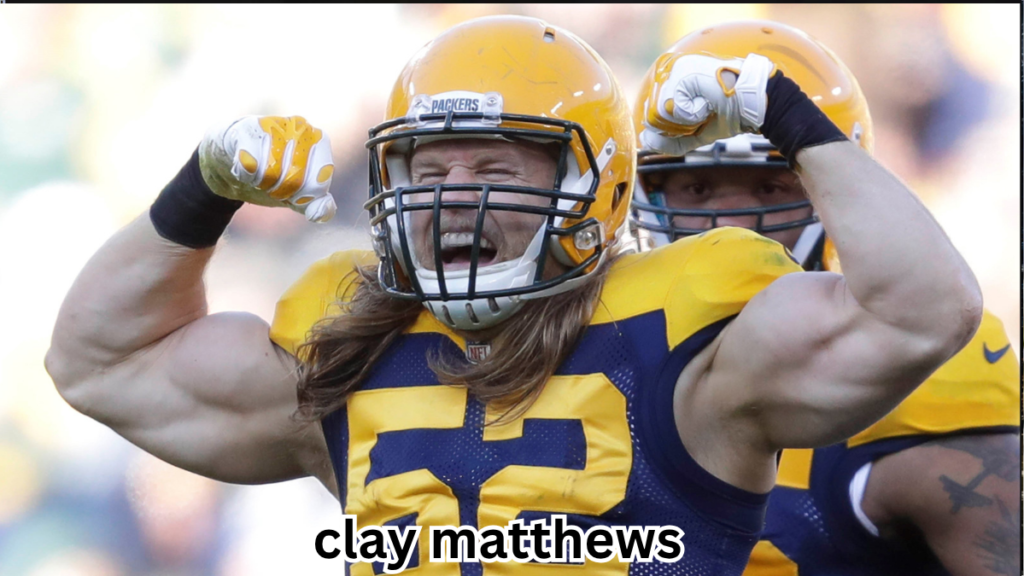
Few modern NFL linebackers combined speed, power, instinct, versatility, and personality quite like clay matthews. From his early days at the University of Southern California to becoming one of the defining defensive players of the Green Bay Packers’ championship era, Matthews built a career that remains memorable long after his final NFL game.
Born into one of football’s most recognizable families, Matthews entered the league with an unusual combination of pedigree and uncertainty. His father, Clay Matthews Jr., had already established himself as an NFL linebacker, while other members of the family had deep connections to professional and college football. Yet the younger Matthews did not enter the NFL as an obvious top prospect from the beginning. His college development came gradually, and his eventual rise became one of the more impressive stories of the 2009 NFL Draft.
Green Bay selected him with the 26th overall pick in the first round, and the decision quickly proved valuable. Matthews recorded 10 sacks as a rookie, earned a Pro Bowl selection, and immediately became one of the most recognizable defensive players on the Packers roster.
His career eventually included six Pro Bowl selections, a first-team All-Pro honor, a Super Bowl XLV championship, and 83.5 sacks with Green Bay. He later added another season with the Los Angeles Rams before leaving the NFL with 91.5 regular-season sacks.
But statistics only tell part of the story. Matthews became important because of how he changed the personality of Green Bay’s defense. He could rush from the edge, move inside, drop into coverage, play special teams, and contribute in high-pressure situations. His versatility allowed defensive coaches to use him in ways that made offensive game planning considerably more complicated.
His most famous moment came during Super Bowl XLV, when he helped create one of the pivotal defensive plays in Packers history. Yet his legacy is broader than one forced fumble or one championship. He became the Packers’ all-time sack leader for the modern statistical era, earned induction into the Packers Hall of Fame in 2024, and remained one of the most respected defenders of his generation.
Early Life and a Remarkable Football Family
The story of clay matthews begins with a football family that had already made its mark before he reached the NFL. William Clay Matthews III was born on May 14, 1986, in Northridge, California. His family background gave him an unusually close connection to professional football, but it also created expectations that could have been difficult for a young athlete to manage.
His father, Clay Matthews Jr., enjoyed a long NFL career as a linebacker with the Cleveland Browns and Atlanta Falcons. His grandfather, Clay Matthews Sr., also played professional football. His uncle Bruce Matthews became one of the most decorated offensive linemen in NFL history, and his brother Casey Matthews later played linebacker for the Philadelphia Eagles. The family tree also includes other NFL players, making football almost a tradition passed between generations.
Growing up around that environment gave Matthews an understanding of professional football that many young athletes do not have. He had access to people who understood the physical and mental demands of the sport, including the importance of preparation, discipline, recovery, and longevity.
At the same time, being part of a famous football family did not automatically guarantee success. Matthews still needed to establish his own identity as a player. His path differed from that of his father and uncle, and his position eventually evolved in response to his own athletic strengths.
That distinction became important throughout his career. Matthews was never simply a younger version of another family member. He developed into a modern hybrid linebacker whose speed allowed him to rush the quarterback while his football intelligence allowed him to move around the formation.
His upbringing also exposed him to the professional side of football. He understood that playing at the highest level involved more than physical talent. Film study, communication, preparation, and consistency all mattered. Those lessons became increasingly visible once he entered the NFL.
The Matthews family name opened doors, but it was Matthews’ performance that ultimately established his reputation. By the time he reached Green Bay, he had created enough separation from his family’s history to become a major football figure in his own right.
High School Development and the Road to USC
Before becoming a professional star, Matthews attended Agoura High School in California. His athletic ability was already evident, but his development was not necessarily following the straightforward path of a five-star prospect destined to dominate college football immediately.
That gradual progression became a recurring theme. Matthews had the physical tools to play at a high level, but he needed experience and opportunity. His time at USC provided both.
Joining the Trojans placed him inside one of the most competitive college football programs in the country. USC had developed a reputation for producing NFL talent, especially during the Pete Carroll era. The program featured numerous future professional players, and Matthews was part of a particularly talented group of linebackers.
His USC career initially involved more of a supporting role. The official USC roster history notes that he was a key backup linebacker and special teams contributor during his junior season. In 2007, he appeared in all 13 games, recording 17 tackles, three tackles for loss, two forced fumbles, a deflection, and two blocked field goals.
Those special teams contributions were significant because they showed a willingness to do more than simply wait for an opportunity at linebacker. Matthews developed a reputation for energy and athleticism, qualities that later became central to his professional identity.
His senior season brought a larger role. USC used him in different defensive formations and asked him to contribute from several positions. The ability to move around the defense gave NFL scouts additional evidence that his athleticism could translate to the professional game.
Matthews was not simply an edge rusher. He was becoming the kind of defender coaches could move around depending on the matchup. That flexibility became one of his greatest assets once he reached Green Bay.
The USC environment also prepared him for the expectations surrounding major college football. Playing for a nationally prominent program meant competing against elite athletes every week while dealing with substantial media attention.
By the end of his college career, Matthews had transformed from a developmental player into a legitimate NFL prospect. His story demonstrated that elite professional careers can emerge from players whose college trajectories are not perfectly linear.
The 2009 NFL Draft and Green Bay’s Bold Decision
The 2009 NFL Draft represented the moment when clay matthews moved from promising USC linebacker to professional football prospect. The Packers ultimately selected him with the 26th overall pick, but getting that opportunity required Green Bay to make an aggressive move.
The Packers traded up to obtain the selection that became Matthews. Green Bay’s willingness to invest draft capital reflected how strongly the organization believed in his athletic profile and potential.
The selection became particularly interesting because Matthews was not viewed as a traditional, highly experienced linebacker prospect. His development had accelerated later in his college career, and scouts were projecting what he could become rather than simply evaluating a long résumé of college production.
Green Bay’s coaching staff believed his speed could translate immediately. The Packers already had a defensive foundation, but they needed explosive young players who could create pressure and disrupt opposing quarterbacks.
Matthews fit that requirement almost perfectly.
His selection also placed him in an organization with a strong defensive tradition. Green Bay expected its linebackers to understand complex responsibilities while remaining capable of attacking quarterbacks and stopping the run.
The transition from USC to the NFL can be difficult, especially for players who are asked to learn more sophisticated defensive schemes. Matthews handled that transition quickly.
His physical abilities were obvious, but his willingness to study and adapt was equally important. The Packers did not simply use him as a one-dimensional pass rusher. They gradually expanded his responsibilities.
The decision to trade up became one of the most successful personnel moves of the era. Matthews became a centerpiece of the Packers defense, and his rookie season immediately suggested that Green Bay had found something special.
A Rookie Season That Changed Expectations
The arrival of clay matthews in Green Bay was immediately noticeable. Rather than spending his rookie season slowly adjusting to professional football, Matthews became a productive defensive contributor from the beginning.
He recorded 10 sacks in 2009, a remarkable total for a rookie linebacker. Those 10 sacks remain the Packers’ franchise rookie record, according to the organization.
The production earned him a Pro Bowl selection and placed him third in Associated Press Defensive Rookie of the Year voting. More importantly, it established him as someone opposing offenses needed to account for.
A rookie who can consistently pressure quarterbacks changes the way offensive coordinators approach games. Tackles may need additional help. Running backs may be asked to block. Quarterbacks may need to speed up their progressions.
Matthews’ explosiveness made those adjustments necessary.
He also developed a reputation for playing with a relentless motor. Green Bay’s official historical profile quotes former linebackers coach Kevin Greene describing Matthews as dynamic in pass rushing, run defense, and coverage.
That assessment captured the core of Matthews’ game. His value was not limited to sack totals. He could affect plays without recording a statistic because quarterbacks had to account for where he might be coming from.
The rookie season also gave Matthews confidence. He had entered the league with questions about how quickly he could develop, and his immediate production answered many of them.
Instead of being viewed as a developmental project, he became one of the young faces of Green Bay’s defense.
The Packers were entering a period in which their defense would become an important component of a championship team. Matthews was arriving at precisely the right moment.
The Breakout 2010 Season
The 2010 season was arguably the defining regular season of clay matthews‘ career. After producing 10 sacks as a rookie, he increased that total to 13.5 sacks in his second season.
The jump demonstrated that his rookie performance was not a fluke. He was becoming a premier pass rusher.
Matthews also finished second in AP Defensive Player of the Year voting and earned first-team All-Pro recognition. The Packers’ official history notes that he became the first Green Bay linebacker in more than two decades to earn that AP first-team All-Pro honor.
His combination of speed and power made him especially difficult for offensive tackles. He could attack the edge, bend around blockers, use his hands effectively, and accelerate toward the quarterback.
Yet his impact extended beyond pass rushing.
Green Bay’s defense became increasingly creative with him. Coaches could move him around before the snap, creating uncertainty about where pressure would come from. His athleticism allowed the defense to disguise its intentions.
That flexibility was particularly valuable in a league increasingly focused on creating favorable matchups.
Matthews also became a major contributor to the Packers’ Super Bowl run. Green Bay finished the postseason with a championship victory over the Pittsburgh Steelers in Super Bowl XLV.
The season therefore represented both individual and team success. Matthews had established himself as one of the NFL’s most dangerous defenders while helping Green Bay reach the top of the league.
It was the kind of season that shaped a player’s reputation for an entire career.
Super Bowl XLV and the Play That Became Part of Packers History
The championship run is central to the legacy of clay matthews, but one particular defensive sequence became especially memorable.
During Super Bowl XLV, Matthews made a major impact with a forced fumble that helped Green Bay maintain momentum. The Packers ultimately defeated the Pittsburgh Steelers 31–25 to claim the championship.
The play became part of Packers history because it represented the type of aggressive, high-energy football Matthews had brought to the team.
Green Bay’s official historical account emphasizes that the forced fumble was one of the biggest defensive plays in the franchise’s Super Bowl history.
The significance of the moment extended beyond the statistic. Championship games are often decided by a handful of critical plays, and Matthews delivered when the stakes were highest.
For a young defender, appearing in a Super Bowl and making a decisive play can permanently change how fans remember a career.
The victory also validated Green Bay’s decision to trade up for him two years earlier. Matthews had gone from promising rookie to championship defender in a remarkably short period.
His performance during the postseason reinforced his reputation as a player who could produce in important situations.
The Packers’ championship also created a lasting association between Matthews and one of the strongest teams of the early 2010s. Aaron Rodgers became the face of the offense, while Matthews emerged as one of the most recognizable defensive stars.
That combination helped define the identity of the franchise during the period.
Even years later, the Super Bowl remains one of the first achievements associated with Matthews whenever his career is discussed.
Becoming the Face of Green Bay’s Defense
After his breakout seasons, clay matthews became more than an effective linebacker. He became one of the recognizable faces of the Packers organization.
His distinctive appearance, aggressive playing style, and production made him highly visible. But his importance to the team was primarily football-related.
Green Bay relied on him to create pressure and provide leadership on defense. As younger players entered the roster, Matthews became one of the veterans responsible for maintaining standards.
The Packers’ defense was not always statistically dominant, but Matthews provided a consistent source of disruption. His ability to generate pressure could change games even when the defense as a whole struggled.
From 2009 through 2017, he accumulated 80 sacks, ranking fifth in the NFL over that span.
That statistic helps explain the scale of his impact. Eighty sacks over nine seasons represents sustained production rather than a brief peak.
He also demonstrated versatility by moving between outside and inside linebacker. That change was not necessarily beneficial to his individual statistics, but it helped the defense.
In 2014, Green Bay asked Matthews to spend more time inside. The move demonstrated his willingness to prioritize team needs over personal statistical opportunities.
Former head coach Mike McCarthy later described the decision as a defensive necessity and recalled that Matthews accepted the switch without hesitation.
That willingness to adapt strengthened his reputation among coaches and teammates.
The move also illustrated an important reality of professional football: individual statistics do not always tell the complete story of a player’s value.
The Inside Linebacker Experiment and Defensive Versatility
One of the most interesting aspects of clay matthews‘ career was his transition from primarily playing outside linebacker to taking significant snaps inside.
The change occurred because Green Bay needed additional flexibility in its defensive structure. Matthews had the athleticism to handle responsibilities away from the edge, including coverage, pursuit, and communication.
Playing inside required different skills. Rather than focusing primarily on rushing the passer, he had to diagnose running plays, communicate assignments, cover receivers, and operate in space.
The Packers ultimately started him at inside linebacker for 25 games across three seasons.
The move affected his sack totals. A player who spends more time inside generally receives different pass-rushing opportunities than an edge defender.
That meant Matthews’ statistical production declined compared with his peak seasons, but his defensive responsibilities expanded.
His willingness to accept that role demonstrated a team-first approach.
It also made him more difficult for offensive coordinators to predict. If a defense could move one of its best athletes around the formation, offenses had fewer opportunities to identify pressure packages before the snap.
Matthews’ versatility therefore became a strategic weapon.
The experience also reinforced the idea that his career should not be evaluated exclusively by sack totals. His impact included coverage, run defense, leadership, communication, and positional flexibility.
In a league where defensive schemes were becoming increasingly complicated, players capable of handling multiple roles became particularly valuable.
Injuries and the Challenge of Sustaining Elite Production
Like many long-career NFL defenders, clay matthews dealt with injuries that affected his availability and production.
The Packers’ official historical profile specifically notes that hamstring injuries hampered him throughout his career.
For an explosive pass rusher, lower-body health is particularly important. Speed, acceleration, balance, and change of direction are all central to beating offensive blockers.
Even minor physical limitations can affect a defender’s ability to bend around the edge or close distance on quarterbacks.
Matthews nevertheless continued to contribute across many seasons.
His ability to remain productive while dealing with physical setbacks speaks to his conditioning and preparation. NFL careers are rarely linear, and maintaining effectiveness after a peak season can be as difficult as reaching that peak initially.
His later career statistics were not as spectacular as the 2010 campaign, but he remained a valuable veteran presence.
The Packers also continued to rely on him in different roles, demonstrating confidence in his football intelligence.
His injury history provides useful context when evaluating his numbers. A player who spends years changing positions and dealing with physical problems may not produce the same statistical totals as a player who remains permanently positioned as an edge rusher.
Nevertheless, Matthews’ overall career production remained impressive.
His 91.5 regular-season sacks rank him among the notable pass rushers of the modern NFL era.
Career Statistics and Major Accomplishments
The statistical record provides a useful snapshot of clay matthews‘ professional career. He played 156 regular-season games and recorded 91.5 sacks across his NFL career, which included time with Green Bay and the Los Angeles Rams.
His Green Bay numbers are especially important because they place him at the top of the franchise’s modern sack rankings. The Packers credit him with 83.5 sacks between 2009 and 2018.
| Career Category | Clay Matthews Record |
|---|---|
| NFL seasons | 11 |
| NFL career | 2009–2019 |
| Regular-season games | 156 |
| Career sacks | 91.5 |
| Packers sacks | 83.5 |
| Packers postseason sacks | 11 |
| Pro Bowl selections | 6 |
| Super Bowl victories | 1 |
| Super Bowl championship | XLV |
| Draft position | 26th overall, 2009 |
| College | USC |
| Primary position | Linebacker |
| Packers career | 2009–2018 |
| Rams career | 2019 |
These numbers show why his career remains significant. Matthews did not merely enjoy a few productive seasons. He accumulated elite totals over more than a decade of professional football.
His six Pro Bowl selections are particularly notable. The Packers have pointed out that his total is tied with Reggie White for the second-most Pro Bowl selections by a defensive player in franchise history.
His postseason production was also important. Matthews recorded 11 sacks in 15 playoff games for Green Bay, a franchise postseason record for the modern sack era.
Those numbers strengthen the argument that his impact was not limited to regular-season statistics.
The Packers All-Time Sack Record
When discussing the legacy of clay matthews, the Packers’ sack record deserves special attention.
Matthews finished his Green Bay career with 83.5 sacks, putting him at the top of the franchise’s all-time list dating back to 1982, when sacks became an official NFL statistic.
Breaking a franchise record is difficult in any sport, but doing so for a team with such a long defensive history carries particular significance.
Green Bay has employed many accomplished pass rushers over the decades. Matthews’ ability to finish above those players reflects both his peak performance and longevity.
The record also demonstrates the consistency of his production. A player cannot reach more than 80 sacks simply through one or two exceptional seasons.
He needed to remain productive year after year.
His rookie season contributed significantly to that total, but his continued production throughout the 2010s ultimately made the record possible.
The achievement became even more meaningful when he was inducted into the Packers Hall of Fame in 2024.
That recognition effectively placed him among the franchise’s most important players, independent of whether he eventually receives broader Hall of Fame recognition.
For Packers fans, the combination of the sack record, six Pro Bowls, and Super Bowl championship gives Matthews a particularly strong historical résumé.
Six Pro Bowls and All-Pro Recognition
The career of clay matthews includes six Pro Bowl selections, reflecting the level of respect he earned during his time in Green Bay.
His first Pro Bowl came after his rookie season, which is remarkable considering he was still learning the professional game.
He returned to the Pro Bowl during later stages of his career and continued to be recognized despite changes in role and injuries.
His strongest individual season came in 2010, when he recorded 13.5 sacks and received first-team All-Pro recognition from the Associated Press.
All-Pro recognition carries a different meaning from a Pro Bowl selection because it reflects evaluation of a player’s performance relative to the entire league.
Matthews’ 2010 season therefore stands as one of the strongest individual defensive performances in Packers history.
His six Pro Bowls also illustrate his longevity. Maintaining league-wide recognition over several seasons requires more than athletic ability. It requires consistent production, health, preparation, and adaptability.
The combination of those qualities helped him remain relevant even as his role changed.
While his later seasons were not as statistically dominant as his early years, the respect he had built within the league continued.
His résumé ultimately became one of the most accomplished defensive careers in Packers history.
The 2018 Season and the End of His Green Bay Era
The final Green Bay season for clay matthews came in 2018. By that point, he had spent a decade with the organization and had experienced dramatic changes in coaching staffs, teammates, schemes, and league trends.
His departure represented the end of an important defensive era.
The Packers allowed his contract to expire after the season, making him a free agent. His time in Green Bay had produced 143 games, 137 starts, 83.5 sacks, six Pro Bowls, and a Super Bowl championship.
Few players remain with one franchise for a decade while maintaining that level of statistical and cultural importance.
Matthews had become closely associated with the Packers’ identity during the 2010s.
Leaving Green Bay was therefore not simply a roster transaction. It marked the conclusion of one of the most recognizable careers in recent franchise history.
The organization had changed significantly since he was drafted in 2009. Aaron Rodgers had become the franchise quarterback, the defense had undergone multiple transformations, and the roster had evolved around them.
Matthews was one of the few constants.
His final season with the Packers also demonstrated the natural aging process of an NFL defender. Explosive edge players face increasing physical challenges as they accumulate years of professional wear.
Nevertheless, he remained capable of contributing.
When his Green Bay contract ended, Matthews still had an opportunity to continue his career elsewhere.
That opportunity came with the Los Angeles Rams.
One Final Season With the Los Angeles Rams
The Los Angeles Rams became the final NFL stop for clay matthews.
Matthews joined the Rams for the 2019 season, giving him an opportunity to play in a different defensive environment after a decade in Green Bay.
The move was significant because the Rams were coming off a Super Bowl appearance and were trying to maintain a championship-caliber roster.
Matthews brought experience to a defensive unit with ambitious goals.
He ultimately played one season in Los Angeles before being released after the 2019 campaign. The Packers’ official historical profile credits him with eight sacks during his final season, while Pro Football Reference records his overall career at 91.5 regular-season sacks.
The Rams season completed an unusual career arc.
Matthews had entered the NFL with Green Bay in 2009 and finished the decade with another team competing at a championship level.
His final season also allowed him to finish his career with more than 90 sacks, an impressive statistical milestone.
After 2019, he did not return to regular-season NFL action.
His departure from professional football was relatively quiet compared with the enormous attention surrounding his early career.
That was appropriate in some ways. Matthews had already accomplished what many players spend their entire careers chasing.
He had won a Super Bowl, earned multiple Pro Bowl selections, become a franchise sack leader, and established himself as one of the most recognizable linebackers of his era.
Packers Hall of Fame Recognition
One of the clearest confirmations of clay matthews‘ importance to Green Bay came in 2024, when he was inducted into the Packers Hall of Fame.
The honor placed him alongside the organization’s most respected former players.
His induction was not based on a single season. It reflected the totality of his decade with the franchise.
He had been part of eight consecutive playoff appearances, three NFC Championship Game appearances, and the Super Bowl XLV championship team. Packers.com highlighted his importance to that sustained period of success.
The Hall of Fame recognition also reinforced the difference between franchise legacy and broader NFL Hall of Fame status.
A player does not need to be universally considered one of the greatest players in league history to become a foundational figure for a specific organization.
Matthews fits that category extremely well.
His name is permanently connected with the Packers’ championship era, and his sack record gives him an unmistakable statistical legacy.
The induction also gave former teammates, coaches, and fans an opportunity to celebrate his career after several years away from the field.
It served as a reminder that football legacies often become clearer with time.
Hall of Fame Debate and His Historical Standing
The Pro Football Hall of Fame question surrounding clay matthews is more complicated.
As of 2026, he has not been elected to the Pro Football Hall of Fame. Pro Football Reference lists him among players with substantial career production but no Hall of Fame election.
However, his candidacy has remained relevant.
In 2025, the Packers announced that Matthews was among the modern-era nominees for the Pro Football Hall of Fame Class of 2026. The organization described him as a six-time Pro Bowler and emphasized his place at the top of Green Bay’s modern sack list.
A Hall of Fame case usually involves more than career totals.
Voters consider peak performance, longevity, postseason success, awards, influence, position standards, and how a player compares with his contemporaries.
Matthews has several strong arguments.
His 2010 season was outstanding. He won a championship. He made six Pro Bowls. He earned first-team All-Pro recognition. He recorded more than 90 career sacks.
He also played in an era when defensive schemes were changing rapidly.
The counterargument is that he did not sustain his early-career level of individual production throughout the entire decade. His sack totals declined after his peak, partly because of injuries and partly because Green Bay moved him inside.
That complexity makes his candidacy interesting.
Regardless of the eventual Hall of Fame outcome, his franchise legacy is already secure.
Playing Style and What Made Him Different
The most memorable quality of clay matthews as a player was his explosiveness.
He could accelerate from a standing position and reach the quarterback quickly. That burst made him especially dangerous on passing downs.
But speed alone does not produce more than 90 career sacks.
Matthews combined acceleration with physical strength and an aggressive playing style. He understood how to attack offensive tackles and use leverage to create favorable angles.
His motor was also a major part of his reputation.
The Packers’ historical profile quotes former defensive back Charles Woodson describing Matthews as fast, big, capable of making different moves, and unwilling to stop pursuing the play.
That description explains why Matthews frequently appeared involved even after the initial play seemed to move away from him.
His pursuit skills allowed him to make plays from behind.
Another important component was anticipation. Elite pass rushers must understand snap timing and offensive tendencies.
Matthews developed the ability to anticipate situations in which pressure opportunities were most likely.
That intelligence helped him remain productive even when offenses adjusted their protection schemes.
His versatility made the problem more complicated.
An offense preparing for an edge rusher can design protection around that threat. An offense preparing for a defender who may line up outside, inside, or drop into coverage faces a different challenge.
That tactical uncertainty became one of Matthews’ greatest strengths.
Leadership Beyond the Box Score
Statistics provide one measure of clay matthews‘ career, but leadership is harder to quantify.
As Matthews moved into his later years, his value increasingly included experience and communication.
Young defenders could learn from a veteran who had already played in multiple NFC Championship Games and a Super Bowl.
He understood how postseason football differed from regular-season football.
He also understood the pressure associated with playing in Green Bay.
The franchise has one of the most passionate fan bases in American sports, and players who become central figures carry considerable expectations.
Matthews handled that attention while continuing to perform.
His ability to adjust positions also demonstrated leadership. Moving inside meant accepting a role that could reduce his personal sack numbers for the benefit of the defense.
That kind of adjustment is common in team sports but often overlooked when evaluating individual careers.
Matthews’ willingness to do it became part of his professional reputation.
His career therefore provides a useful example of how elite athletes can contribute even when their statistical role changes.
Leadership does not always mean giving speeches or being the loudest player.
Sometimes it means accepting a less glamorous assignment because the team needs it.

The Business of Being an NFL Star
The financial side of clay matthews‘ career is also worth examining, although exact personal net worth figures are not reliably established through public records.
NFL players can generate income through contracts, performance incentives, endorsements, appearances, investments, and business activities.
A player who becomes a recognizable national personality can have earning opportunities beyond the salary listed in a football contract.
Matthews’ visibility during the Packers’ championship era made him a recognizable figure far beyond Green Bay.
His distinctive appearance and aggressive playing style helped establish a memorable public identity.
However, celebrity wealth should always be treated carefully.
Public estimates of athlete net worth often rely on incomplete information. Contract values can be reported publicly, but taxes, spending, investments, private businesses, property values, and financial obligations are generally not fully visible.
For that reason, it is more useful to focus on the documented career achievements and publicly reported football earnings rather than presenting an unsupported net worth figure as fact.
Matthews’ strongest financial asset was his decade-long NFL career.
Sustained professional success provides a player with opportunities to build long-term financial security.
His career also illustrates how athletic longevity can create value beyond the playing field.
Family Legacy and the Matthews Football Dynasty
Few NFL families have produced a football lineage quite like the Matthews family.
The family includes multiple generations of professional players, making clay matthews part of one of the most recognizable football dynasties in American sports.
His father, Clay Matthews Jr., had a long NFL career. His uncle Bruce Matthews became a Hall of Fame offensive lineman and one of the most respected players of his era.
His brother Casey Matthews also reached the NFL.
The family connection extends beyond names on jerseys. It reflects a shared understanding of professional football.
Growing up in such an environment likely exposed Matthews to concepts that other young players encounter much later.
The family legacy also created pressure.
Every time Matthews succeeded, comparisons with relatives were inevitable.
Yet he ultimately established a distinct identity.
His career was built around the linebacker position, while Bruce Matthews became famous as an offensive lineman and Clay Matthews Jr. built his own legacy as a long-tenured defender.
The younger Matthews therefore became another chapter rather than merely a continuation of someone else’s story.
That distinction matters because family fame can create expectations but cannot produce NFL sacks.
Matthews had to earn every accomplishment himself.
Why His 2010 Season Remains So Important
When evaluating clay matthews, the 2010 season deserves special emphasis because it represented the peak of his individual dominance.
His 13.5 sacks were a career high.
He also received first-team All-Pro recognition and finished second in Defensive Player of the Year voting.
The season came at an ideal time for the Packers.
Green Bay’s defense was becoming a championship-level unit, and Matthews’ pass-rushing ability provided a major source of pressure.
The team’s success culminated in Super Bowl XLV.
For Matthews personally, the season established him as one of the NFL’s elite defensive players.
Few young players can combine personal awards with a championship during the same season.
His 2010 campaign remains the clearest illustration of what he could become when healthy, positioned primarily as an edge defender, and given opportunities to attack quarterbacks.
Later seasons were different, but they do not diminish the significance of that peak.
In fact, the contrast helps explain why his career is so interesting.
He was not simply a player who accumulated statistics over many years.
He also experienced a short period in which he was among the most feared defenders in the league.
The Importance of Scheme in His Career
One of the most overlooked elements of clay matthews‘ career is how much defensive scheme influenced his statistics.
Football statistics often appear objective, but a player’s opportunities depend heavily on coaching decisions.
An outside linebacker assigned to rush the passer frequently will naturally have more sack opportunities than an inside linebacker asked to defend running lanes or cover receivers.
Matthews experienced both roles.
When Green Bay moved him inside, his sack production changed.
That does not necessarily mean he became a worse player.
Instead, his responsibilities changed.
The Packers’ coaching staff valued his intelligence and athleticism enough to use him where the defense needed help.
That flexibility may have reduced his individual statistical ceiling while increasing his overall value to the team.
Modern football increasingly recognizes this distinction.
Defensive players who can execute multiple responsibilities allow coaches to create more complicated schemes.
Matthews was an early example of that kind of hybrid defensive player.
His career therefore offers an interesting case study in why statistics must be considered within context.
A sack total is valuable, but understanding where and how a player was deployed provides a more complete picture.
Post-NFL Legacy and Lasting Recognition
Since leaving professional football, clay matthews has increasingly been remembered through the lens of his accomplishments rather than his day-to-day playing career.
The Packers Hall of Fame induction in 2024 was a major part of that process.
His selection for the Packers’ Hall of Fame recognized the combination of production, longevity, championship success, and cultural importance he brought to the organization.
His nomination for the Pro Football Hall of Fame Class of 2026 further demonstrated that his career remains part of the broader NFL historical conversation.
Whether or not he eventually receives a bust in Canton, his career has already earned a permanent place in Packers history.
The franchise sack record is one reason.
The Super Bowl championship is another.
The six Pro Bowls and All-Pro season provide additional evidence.
Perhaps most importantly, fans remember Matthews because he played with a distinctive style.
He looked like a traditional linebacker but could function as a modern pass-rushing weapon.
He brought energy to the defense and regularly produced moments that changed games.
That combination of statistics and personality is difficult to replicate.
Lessons From a Career Built on Adaptability
The career of clay matthews provides several broader lessons about professional sports.
The first is that development does not always happen on a predictable timeline.
Matthews was not an established USC starter from the beginning of his college career. His role expanded, his skills developed, and his professional opportunity eventually arrived.
The second lesson is that versatility can extend a career.
Matthews was able to play outside linebacker, move inside, contribute in coverage, rush the quarterback, and handle different assignments.
That adaptability gave coaches more reasons to keep him on the field.
The third lesson is that team success can shape individual legacy.
Matthews’ career would be remembered differently without Super Bowl XLV.
Championships create a lasting context around individual achievements.
The fourth lesson is that statistics require context.
His 91.5 career sacks are impressive, but the number becomes more meaningful when combined with his positional changes and defensive responsibilities.
Finally, his career demonstrates the value of consistency.
He did not need to record 13.5 sacks every season to build a significant legacy.
He needed to remain productive, healthy enough to contribute, and adaptable enough to serve his team.
That is exactly what he did.
What Makes His Packers Legacy Special
The legacy of clay matthews in Green Bay rests on several pillars.
First, there is production. His 83.5 Packers sacks remain the franchise’s modern-era record.
Second, there is recognition. Six Pro Bowl selections demonstrate sustained league-wide respect.
Third, there is postseason performance. His 11 Packers playoff sacks demonstrate that he remained productive when the stakes increased.
Fourth, there is championship success. He helped the Packers win Super Bowl XLV.
Fifth, there is adaptability. He accepted changes in defensive role and continued contributing.
Finally, there is cultural identity.
Some players are remembered primarily for statistics.
Others become symbols of a particular era.
Matthews belongs to the second category.
For many Packers fans, seeing him line up across from an offensive tackle immediately evokes the team’s championship period under Mike McCarthy.
His blond hair, No. 52 jersey, explosive pass rush, and relentless pursuit became part of the visual identity of Packers football during the early 2010s.
That kind of recognition is difficult to manufacture.
It develops naturally through years of meaningful performances.
Conclusion: A Lasting NFL Legacy
The story of clay matthews is ultimately a story about development, adaptability, production, and championship football.
He entered the NFL in 2009 after being selected 26th overall by the Green Bay Packers. Almost immediately, he demonstrated that he belonged at the highest level.
His 10-sack rookie season established his credibility.
His 13.5-sack 2010 campaign elevated him into the league’s elite defensive class.
His Super Bowl XLV performance gave him championship credibility.
His six Pro Bowl selections established longevity.
His 83.5 Packers sacks established a franchise record.
His 91.5 career sacks placed him among the most productive pass rushers of his era.
And his 2024 induction into the Packers Hall of Fame cemented his importance to the organization.
What makes the career particularly compelling is that Matthews was willing to change.
He moved from outside linebacker to inside linebacker when the defense required it. He continued contributing despite injuries. He adapted to different coaching strategies and eventually completed his career with the Rams.
His career was not defined by one statistical category.
It was defined by his ability to influence games in multiple ways.
For Packers fans, he will always be connected to the team’s championship era.
For NFL historians, he represents an important example of the modern versatile linebacker.
For football families, he remains another remarkable chapter in one of the sport’s great dynasties.
And for anyone studying professional athletic careers, his journey offers an important reminder that greatness is rarely a straight line.
Sometimes it begins with a developmental role, grows through opportunity, reaches an extraordinary peak, and then evolves through adaptation.
That is the career Matthews built.
His playing days may be finished, but his place in Green Bay football history is secure.
Frequently Asked Questions
When was Clay Matthews born?
Clay Matthews was born on May 14, 1986, in Northridge, California. His full name is William Clay Matthews III, and he comes from a prominent football family that includes his father Clay Matthews Jr. and uncle Bruce Matthews.
How many sacks did Clay Matthews have in his NFL career?
Clay Matthews finished his NFL career with 91.5 regular-season sacks. He recorded 83.5 of those sacks during his decade with the Green Bay Packers and added the remainder during his final season with the Los Angeles Rams.
How many Pro Bowls did Clay Matthews make?
Clay Matthews was selected to six Pro Bowls during his Green Bay career. The Packers note that his six selections are tied with Reggie White for the second-most Pro Bowl selections by a defensive player in franchise history.
Did Clay Matthews win a Super Bowl?
Yes. Clay Matthews won Super Bowl XLV with the Green Bay Packers during the 2010 season. He played an important role in the Packers’ championship defense and made a memorable forced fumble during the game.
What was Clay Matthews’ best NFL season?
His 2010 season is generally considered his strongest individual campaign. He recorded a career-high 13.5 sacks, earned first-team Associated Press All-Pro recognition, finished second in Defensive Player of the Year voting, and helped Green Bay win Super Bowl XLV.
What team drafted Clay Matthews?
The Green Bay Packers selected Clay Matthews with the 26th overall pick in the first round of the 2009 NFL Draft. Green Bay traded up to acquire the selection used to draft him.
Did Clay Matthews play for the Los Angeles Rams?
Yes. After spending the first ten seasons of his NFL career with Green Bay, Matthews joined the Los Angeles Rams for the 2019 season. That was the final season of his professional playing career.
Is Clay Matthews in the Packers Hall of Fame?
Yes. Clay Matthews was inducted into the Green Bay Packers Hall of Fame in 2024. The honor recognized his decade with the organization, franchise sack record, six Pro Bowl selections, postseason production, and role on the Super Bowl XLV championship team.
Is Clay Matthews in the Pro Football Hall of Fame?
As of 2026, Clay Matthews has not been elected to the Pro Football Hall of Fame. However, he was among the modern-era nominees for the Class of 2026, keeping his candidacy part of the ongoing Hall of Fame discussion.
What is Clay Matthews’ Packers sack record?
Clay Matthews finished his Packers career with 83.5 sacks, which ranks first on the franchise’s all-time sack list dating to 1982, when sacks became an official statistic. His total remains one of the clearest statistical markers of his Green Bay legacy.
What college did Clay Matthews attend?
Clay Matthews attended the University of Southern California, where he played for the Trojans. He initially contributed as a backup linebacker and special teams player before taking on a larger role. USC later produced him as a first-round NFL draft selection in 2009.
Who is Clay Matthews’ father?
His father is Clay Matthews Jr., a former NFL linebacker who played for the Cleveland Browns and Atlanta Falcons. His uncle is Bruce Matthews, a Pro Football Hall of Fame offensive lineman. The Matthews family has produced multiple NFL players across several generations.