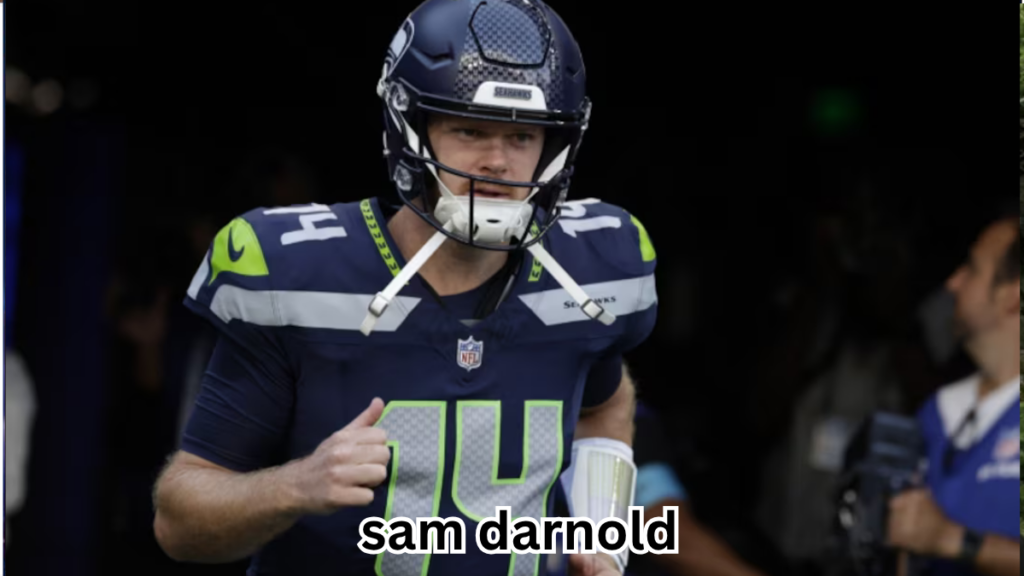
Sam Darnold’s NFL career is one of the more unusual quarterback stories of the modern era. A highly regarded first-round pick who entered the league with enormous expectations, he spent his early professional years trying to prove that his talent could translate into consistent NFL production. The path was anything but straightforward. He moved from the New York Jets to the Carolina Panthers, then to the San Francisco 49ers as a backup before getting a major opportunity with the Minnesota Vikings. What happened next changed the direction of his career.
After years of uncertainty, Darnold delivered a breakout 2024 season in Minnesota, throwing for 4,319 yards, 35 touchdowns, and 12 interceptions while helping the Vikings finish 14-3. That performance earned him Pro Bowl recognition and transformed his free-agent market. Seattle responded by signing him to a three-year, $100.5 million contract with $55 million guaranteed in March 2025.
His first season with the Seahawks then produced another remarkable chapter. Darnold threw for 4,048 yards, 25 touchdowns, and 14 interceptions in 2025, posting a 99.1 passer rating while leading Seattle to a franchise-record 14 regular-season victories and the NFC’s No. 1 seed. The Seahawks went on to win Super Bowl LX, defeating the New England Patriots 29-13.
The story became even more interesting in September 2026. Darnold entered his second Seattle season as the reigning Super Bowl-winning quarterback, but he exited the Seahawks’ season opener against New England with a right hip injury. Initial X-rays and a CT scan showed no fracture, while an MRI was scheduled for further evaluation. Seattle ultimately rallied behind Drew Lock to defeat the Patriots 13-10.
That latest development adds another layer to a career defined by resilience. Darnold has already experienced the extreme highs and lows of professional football: top-three draft selection, disappointing seasons, bench roles, career uncertainty, a Pro Bowl, a massive contract, and a Super Bowl championship. His journey offers a useful look at how quarterback development rarely follows a straight line.
Early Life and the Foundation of a Quarterback
Born June 5, 1997, in Capistrano Beach, California, Darnold grew up in Southern California, a region deeply connected to football culture. He eventually became one of the country’s most closely watched quarterback prospects at San Clemente High School before taking his talents to USC. His physical profile was immediately appealing: at 6-foot-3 and roughly 225 pounds, he possessed the size NFL scouts traditionally want from a pocket passer, along with mobility and natural throwing ability.
The USC years became the foundation of his national reputation. Darnold did not arrive as an instant superstar who dominated from his first snap. Instead, he developed rapidly and became the starter during the 2016 season. Once he took over, the Trojans changed dramatically, finishing the season with a nine-game winning streak and earning a place in the Rose Bowl.
That transformation was important because it demonstrated several traits scouts would later associate with him. He could make throws from different platforms, extend plays when protection broke down, and attack downfield without needing a perfectly clean pocket. He also showed enough athleticism to turn broken plays into positive yardage.
USC’s 2016 campaign became a breakthrough moment. Darnold completed 67.2 percent of his passes for 3,086 yards and 31 touchdowns with only nine interceptions. He was named the Pac-12 Offensive Freshman of the Year and received the Archie Griffin Award, while USC highlighted his poise, accuracy, mobility, and ability to elevate the offense.
The following season confirmed that the breakout was not a fluke. In 2017, Darnold threw for 4,143 yards and 26 touchdowns, while USC won the Pac-12 title. He finished his two-year USC starting career with 7,229 passing yards and 57 touchdown passes, going 20-4 as a starter.
The Rose Bowl Performance That Changed Everything
The 2017 Rose Bowl became one of the defining performances of Darnold’s college career. USC faced Penn State in a spectacular game that ended 52-49, and the young quarterback produced a performance that remains central to his prospect story.
Darnold completed 33 of 53 passes for 453 yards and five touchdowns. He also produced 473 total yards, setting Rose Bowl records for touchdown passes and total offense. In the fourth quarter, he completed all 10 of his passes for 135 yards while helping USC engineer two late touchdown drives to tie the game.
That performance mattered because NFL scouts could see the combination of arm strength, competitiveness, mobility, and late-game composure in a major environment. The Rose Bowl is one of college football’s most visible stages, and Darnold looked comfortable operating under pressure.
His decision-making was not flawless, even at USC. Like many aggressive young quarterbacks, he sometimes attempted throws that were not available. He could be overly willing to trust his arm, especially when a safer decision would have been preferable. Yet that aggressiveness also helped create some of his most impressive plays.
The NFL would eventually expose both sides of that equation. His confidence and physical ability allowed him to make throws that many quarterbacks could not attempt. At the same time, his willingness to attack difficult windows sometimes contributed to turnovers and inconsistent stretches.
Those contradictions became central to the debate surrounding his professional future.
Entering the NFL as the No. 3 Pick
The New York Jets selected Darnold with the third overall pick in the 2018 NFL Draft. USC described him as its highest NFL selection since Reggie Bush in 2006 and the school’s highest-drafted quarterback since Carson Palmer went first overall in 2003.
The selection reflected the expectations surrounding him. The Jets were not drafting a developmental quarterback intended to sit for several years. They believed they had found a potential franchise passer who could eventually become the centerpiece of the organization.
That created enormous pressure from the beginning. Quarterbacks selected near the top of the draft are judged not only by their statistics but also by whether the entire franchise improves around them.
Darnold’s rookie season showed flashes of what made him attractive as a prospect. He finished 2018 with 2,865 passing yards, 17 touchdowns, and 15 interceptions while completing 57.7 percent of his passes. His 77.6 passer rating reflected a difficult introduction to professional football.
The numbers were mixed, but the context mattered. The Jets were still trying to build a reliable supporting structure, and Darnold was learning how quickly NFL defenses could disguise coverages and punish mistakes.
The most memorable problem from his early career came from his tendency to hold the ball too long and attempt difficult throws. These issues were not unusual for a young quarterback, but because of his draft position, every mistake received significant attention.
The narrative surrounding him began to form quickly: talented, physically gifted, but inconsistent.
The 2019 Season and Signs of Progress
Darnold’s second season offered evidence that development was possible. In 2019, he appeared in 13 games and threw for 3,024 yards, 19 touchdowns, and 13 interceptions. His completion rate improved to 61.9 percent, while his passer rating rose to 84.3.
There were stretches in which he looked like the quarterback the Jets had envisioned. His arm strength allowed him to attack deep portions of the field, and his movement outside the pocket created opportunities that were not available to more stationary passers.
Yet consistency remained the central issue. A quarterback can produce spectacular plays and still struggle if negative plays arrive too frequently.
That was particularly difficult for Darnold because his style encouraged risk. He often wanted to create something rather than simply accept a short completion. In college, that instinct could turn into explosive gains. In the NFL, the same decision could produce an interception or a sack.
The 2019 season therefore became a mixture of encouragement and frustration. His statistics improved, but the Jets still did not look like a stable long-term quarterback situation.
The following year would become much harder.
The Difficult 2020 Season
The 2020 season was one of the lowest points of his early career. Darnold appeared in 12 games and threw for 2,208 yards, nine touchdowns, and 11 interceptions, finishing with a 72.7 passer rating. He completed only 59.6 percent of his attempts.
The Jets struggled badly as a team, and the offense lacked consistency. Injuries, protection problems, coaching changes, and organizational uncertainty made it difficult for the quarterback to establish momentum.
For Darnold, the situation became a classic NFL debate. Was the player failing because he lacked the necessary qualities to become a franchise quarterback, or was the environment preventing him from reaching his potential?
Both explanations contained elements of truth. His own mistakes were real, but so were the structural problems around him.
The Jets eventually decided to move on, trading Darnold to Carolina in April 2021. The move effectively ended his first chapter and gave him an opportunity to restart his career somewhere else.
It was a major moment because highly drafted quarterbacks rarely receive unlimited chances. Once a team decides it needs a new quarterback, the player’s reputation can change quickly.
Darnold needed a reset.
Carolina and the Search for Stability
The Carolina Panthers acquired Darnold hoping that a change of scenery could unlock the talent that had made him a top-three pick. He opened the 2021 season as the team’s starter and produced some promising early performances.
However, injuries and inconsistent play again disrupted his progress. He suffered a shoulder injury that landed him on injured reserve before returning later in the season.
Across 12 games in 2021, he threw for 2,527 yards, nine touchdowns, and 13 interceptions. His passer rating was 71.9. The statistical line reinforced the idea that his career had stalled.
The Panthers eventually moved toward another quarterback solution, and Darnold entered the 2022 season facing more uncertainty.
He did get another opportunity late in that season. In six games, he threw for 1,143 yards, seven touchdowns, and three interceptions, posting a much better 92.6 passer rating. The sample was small, but the efficiency was encouraging.
That short stretch mattered because it provided another piece of evidence that the underlying player had not disappeared. He could still make accurate throws, push the ball vertically, and operate effectively when the surrounding environment was functional.
But by then, his reputation had changed. He was no longer viewed primarily as a future franchise quarterback. He was becoming a reclamation project.
That change in perception ultimately became one of the most important developments of his career.
San Francisco and the Value of a Backup Role
In 2023, Darnold signed with the San Francisco 49ers. The role was very different from what he had experienced in New York and Carolina.
Instead of being asked to rescue a franchise immediately, he became a backup behind Brock Purdy in Kyle Shanahan’s offense. That allowed him to learn without the same weekly pressure.
Darnold appeared in 10 games but started only one, completing 28 of 46 passes for 297 yards, two touchdowns, and one interception.
Statistically, it was not a significant season. Developmentally, however, it may have been one of the most important.
Being around an organization with a strong offensive structure gave him exposure to different ways of preparing, reading defenses, operating within a system, and understanding how efficient quarterback play could support a talented roster.
He also worked with Klint Kubiak, who was the 49ers’ passing game coordinator in 2023 and later became Seattle’s offensive coordinator when Darnold joined the Seahawks.
That relationship would become increasingly important.
San Francisco also reached the Super Bowl during Darnold’s time there, giving him a close look at what a championship-level organization required. He was not the starting quarterback, but being part of that environment provided valuable experience.
The lesson was simple: sometimes stepping away from the spotlight can help a quarterback rebuild.
The Minnesota Opportunity
When the Minnesota Vikings signed Darnold to a one-year contract in March 2024, the move did not initially look like one of the biggest quarterback stories in the league.
The deal was structured as a bridge arrangement, with a maximum value of $10 million and $8.75 million guaranteed.
The Vikings originally expected rookie quarterback J.J. McCarthy to be part of the long-term plan, while Darnold provided experienced competition and insurance.
Then everything changed.
McCarthy suffered a season-ending knee injury during the preseason, forcing Darnold into the starting role. Suddenly, a quarterback who had spent the previous season as a backup was responsible for leading a team with playoff expectations.
It was arguably the biggest opportunity of his career.
Instead of trying to prove he could still belong in the NFL, he finally had a well-designed offense, established coaching, strong receivers, and a stable organizational structure.
The results were extraordinary.
The 2024 Breakout
Darnold’s 2024 season was the statistical breakthrough that changed how the league viewed him. He started all 17 regular-season games for Minnesota and threw for 4,319 yards, 35 touchdowns, and 12 interceptions. His 66.2 percent completion rate and 102.5 passer rating were both career bests at the time.
The Vikings finished 14-3, their most regular-season wins in the 21st century at that point, and Darnold earned his first Pro Bowl selection. Seattle later cited that season as the foundation for its decision to make him its starting quarterback.
The improvement was not simply about statistics. His pocket management appeared more controlled, his decision-making was more mature, and his ability to work within an offensive structure was much clearer.
Justin Jefferson gave him an elite outside target. Jordan Addison provided another dynamic receiving threat. T.J. Hockenson added a versatile tight end, while the coaching staff created concepts that regularly gave the quarterback answers before and after the snap.
That supporting cast mattered, but it would be unfair to reduce the season to the players around him. Darnold still had to execute.
His deep passing became a major strength. He was willing to challenge defenses vertically and had enough arm talent to make difficult throws outside the numbers.
The biggest improvement may have been his ability to avoid turning every difficult play into a disaster. Experience had taught him that sometimes the best quarterback decision is simply to live for the next down.
That maturity became one of the defining characteristics of his turnaround.
The Difficult End to the Vikings Season
The 2024 Vikings season ended in disappointing fashion. Minnesota entered the playoffs with a strong record but lost to the Los Angeles Rams in the wild-card round.
Darnold struggled in the game, completing 25 of 40 passes for 245 yards, one touchdown, and one interception while taking nine sacks. The result reopened some of the doubts that had surrounded him earlier in his career.
The contrast was striking. During the regular season, he had looked like a quarterback capable of leading a high-level offense. In the postseason, pressure exposed some of the old problems.
That does not erase the regular-season achievement, but it explains why his free agency became more complicated than a simple bidding war for a proven superstar.
Teams saw a quarterback with elite production and real physical ability, but they also saw a player whose career had included significant inconsistency.
Seattle ultimately decided the upside was worth the investment.
The Seahawks Bet
The Seahawks signed Darnold in March 2025 to a three-year, $100.5 million contract containing $55 million guaranteed. The move came after Seattle traded Geno Smith to the Las Vegas Raiders and restructured its offense around a new quarterback.
The contract was significant because it represented more than a simple bridge arrangement. Seattle was betting that the version of Darnold seen in Minnesota was sustainable.
The timing also reunited him with Klint Kubiak, giving Seattle a quarterback who already understood concepts associated with its new offensive direction.
Seattle’s decision attracted plenty of attention because Darnold’s career had been so unpredictable. A player who once looked like a failed top-three pick was suddenly receiving a nine-figure contract.
That contrast is one of the most fascinating parts of his story.
The deal also placed new pressure on him. A quarterback on a modest one-year contract can surprise people. A quarterback earning more than $100 million is evaluated differently.
Every interception becomes part of the contract conversation. Every bad game invites comparisons to the player’s earlier failures. Every strong performance becomes evidence that the turnaround was legitimate.
Darnold entered Seattle needing to prove that his Minnesota season was the beginning of a new chapter rather than an isolated peak.
A Career Comparison at a Glance
| Stage | Team | Games | Passing Yards | TD | INT | Passer Rating |
|---|---|---|---|---|---|---|
| 2018 | New York Jets | 13 | 2,865 | 17 | 15 | 77.6 |
| 2019 | New York Jets | 13 | 3,024 | 19 | 13 | 84.3 |
| 2020 | New York Jets | 12 | 2,208 | 9 | 11 | 72.7 |
| 2021 | Carolina Panthers | 12 | 2,527 | 9 | 13 | 71.9 |
| 2022 | Carolina Panthers | 6 | 1,143 | 7 | 3 | 92.6 |
| 2023 | San Francisco 49ers | 10 | 297 | 2 | 1 | 85.1 |
| 2024 | Minnesota Vikings | 17 | 4,319 | 35 | 12 | 102.5 |
| 2025 | Seattle Seahawks | 17 | 4,048 | 25 | 14 | 99.1 |
| Career | Multiple teams | 100 | 20,431 | 123 | 82 | 86.5 |
NFL career statistics show just how dramatic the transformation has been. Through the 2025 regular season, Darnold had appeared in 100 games, starting 90, and accumulated 20,431 passing yards, 123 touchdown passes, 82 interceptions, and an 86.5 career passer rating.
The table also reveals why his career is so difficult to summarize with a single label. The early seasons show inconsistency, while the Minnesota and Seattle seasons demonstrate a much more productive quarterback.
The 2025 Seahawks Season
Darnold’s first season in Seattle was not a carbon copy of his 2024 breakout, but it was highly successful.
He completed 323 of 477 passes for 4,048 yards, 25 touchdowns, and 14 interceptions. His 67.7 percent completion rate and 99.1 passer rating were both excellent, while his 8.5 yards per attempt ranked among the league’s strongest marks.
Seattle finished 14-3 and earned the NFC’s No. 1 seed. The Seahawks’ roster was built around balance, with an excellent defense and strong running game complementing the passing offense.
That structure was important. Seattle did not require Darnold to throw 40 or 45 times every week. The offense could remain balanced, allowing the quarterback to attack defenses without carrying the entire burden.
At the same time, Darnold delivered enough explosive plays to keep defenses from crowding the line of scrimmage.
His 57 completions of at least 20 yards demonstrated the big-play ability that had always been part of his physical skill set.
The season also demonstrated his ability to recover from poor stretches. Not every game was efficient, and there were losses in which turnovers became a major issue. Yet Seattle consistently found ways to win enough games to control the NFC playoff picture.
That is an important distinction from his early Jets years.
The Seahawks Offense and Supporting Cast
The success of the 2025 Seahawks was not solely a quarterback story. Football is an interconnected sport, and Darnold benefited from a roster capable of controlling games in multiple ways.
The running game featured Kenneth Walker III and Zach Charbonnet, who combined for substantial production. Seattle’s official statistics show Walker rushing for 1,027 yards and Charbonnet for 730, giving the offense a dependable ground component.
That balance mattered because defenses could not simply sit back and force Darnold to win every down.
The receiving corps also gave him useful options. Jaxon Smith-Njigba developed into a major target and became particularly important during the playoff run. Cooper Kupp added veteran experience after joining Seattle, while the offense maintained multiple avenues for creating explosive plays.
Darnold’s ability to distribute the ball allowed Seattle to avoid becoming predictable.
The relationship between quarterback and play-caller also mattered. The Seahawks entered the season with a new offensive structure, and Darnold’s familiarity with Kubiak helped provide continuity.
Good quarterback play is rarely created in isolation. Protection, route design, receiver separation, run-game efficiency, and coaching all influence what the passer can accomplish.
The Seattle experience reinforced that point.
The NFC Championship Game Breakthrough
The 2025 NFC Championship Game against the Los Angeles Rams became one of the most important performances of Darnold’s career.
Seattle defeated the Rams 31-27, and Darnold produced one of his best postseason games. He completed 25 of 36 passes for 346 yards and three touchdowns without throwing an interception, finishing with a 127.8 passer rating.
The game was particularly meaningful because it came against a talented Rams defense and with a Super Bowl berth on the line.
Darnold connected with Jaxon Smith-Njigba for a touchdown, hit Cooper Kupp for another, and found Jake Bobo for a third score. The passing attack repeatedly produced when Seattle needed points.
That performance also changed the postseason narrative surrounding him.
The previous year, his playoff loss with Minnesota had become evidence for skeptics. Now, he had answered with a championship-game performance worthy of a starting quarterback.
The game-winning environment suited the version of Darnold Seattle had invested in: aggressive, confident, accurate, and capable of producing explosive throws without giving the opponent extra possessions through interceptions.
It was the type of performance that turns a career narrative around.
Super Bowl LX and the Championship Season
Seattle advanced to Super Bowl LX against the New England Patriots, setting up a rematch between two teams that had built their seasons around strong defenses and efficient offensive football.
The Seahawks won 29-13, claiming the second Super Bowl championship in franchise history. Darnold threw a touchdown pass to tight end AJ Barner, while Seattle’s defense controlled the game and limited New England for most of the afternoon.
Darnold finished the Super Bowl 19-of-38 for 202 yards and one touchdown without an interception. His passer rating was 74.7.
Those numbers were not spectacular, but that is part of what makes the championship meaningful.
He did not need to throw for 400 yards. Seattle’s defense and kicking game carried much of the contest, while Darnold avoided catastrophic mistakes and delivered the throws his team needed.
That is an important part of understanding quarterback play. Championships are not always won by the quarterback with the biggest statistical line. Sometimes the quarterback’s job is to complement an elite roster and make enough decisive plays.
Darnold’s touchdown pass to Barner came after a defensive takeaway created a short field. It was a good example of complementary football.
The championship also dramatically altered the context of his career. A former top-three pick who had spent years trying to establish himself had now become the starting quarterback of a Super Bowl-winning team.
The Meaning of the Super Bowl for His Legacy
Winning a Super Bowl does not automatically transform a quarterback into an all-time great. Context matters, and Seattle’s defense was central to its championship.
Still, the title has enormous significance for Darnold’s legacy because of where he started.
The narrative around him for years was centered on unrealized potential. He was the talented quarterback who had never quite put everything together.
After the 2025 season, that description was no longer sufficient.
He had won a playoff game, dominated in a conference championship, and helped guide Seattle to a Super Bowl victory.
The championship also strengthened the argument that quarterback development can happen later than expected.
Darnold was 28 during the 2025 season. That is not old for an NFL quarterback, but it was late enough in his career that many people had already reached conclusions about his ceiling.
His turnaround demonstrated why patience can sometimes be valuable.
The Seahawks did not need him to become the same quarterback he was projected to be in 2018. They needed him to become the best version of the player he had developed into after seven years of NFL experience.
That distinction may be the most important lesson from his career.
Playing Style and Strengths
Darnold’s physical tools have never been the main question. His arm strength is one of his defining assets, and he can drive the ball into tight windows from different platforms.
He also has enough mobility to escape pressure and extend plays. He is not a designed-run quarterback in the same category as Lamar Jackson or Jalen Hurts, but he can move effectively when the pocket collapses.
His throwing ability becomes particularly valuable outside structure. When protection breaks down, he can create additional time and attempt difficult throws.
Another strength is vertical passing. The 8.5 yards-per-attempt figure from 2025 demonstrates his willingness and ability to attack downfield.
His development has also improved his ability to operate within structure. Rather than constantly searching for the spectacular play, he has become more comfortable taking what defenses provide.
That combination of structure and aggression is central to his success.
A quarterback who only plays safely can become predictable. A quarterback who only attacks aggressively can become turnover-prone. The best version of Darnold operates between those extremes.
Pocket Movement and Play Extension
Pocket movement has always been one of the more interesting aspects of his game. His instincts can sometimes lead him into trouble, but when he moves effectively, the result can be highly productive.
He is comfortable sliding away from pressure, changing launch points, and buying time for receivers to uncover.
That skill is especially valuable in modern NFL offenses, where defensive linemen are faster and quarterbacks face pressure from increasingly sophisticated fronts.
The challenge is knowing when to extend a play and when to accept the end of the down.
Earlier in his career, Darnold often appeared determined to make something happen. That mentality produced spectacular plays but also unnecessary sacks and turnovers.
With experience, he has become better at recognizing when a play has reached its natural conclusion.
The improvement may not appear in one statistic, but it is visible in the broader efficiency of his recent seasons.
Quarterback development often looks like this. Physical tools are present early, while decision-making improves later.
Accuracy and Decision-Making
Accuracy is not simply completion percentage. A quarterback can complete a high percentage of short throws without being particularly effective, while another passer can have a lower percentage because he consistently attempts difficult downfield passes.
Darnold’s recent seasons demonstrate a more balanced approach.
His 2024 completion rate of 66.2 percent was a career best at that time, followed by 67.7 percent in 2025. His passer ratings of 102.5 and 99.1 across those two seasons also show a sustained level of efficiency.
The most encouraging element is that the improvement happened over a meaningful sample rather than a few games.
He played all 17 regular-season games in both 2024 and 2025.
Durability matters because quarterbacks cannot establish a new reputation if they repeatedly disappear from the lineup.
His decision-making is still not perfect. The 14 interceptions in 2025 demonstrate that turnovers remain part of the equation.
But context matters. Seattle still won 14 regular-season games and finished with the NFC’s top seed.
The goal is not to eliminate every mistake. It is to ensure that mistakes do not become more damaging than the positive plays being generated.

The Importance of Coaching in His Development
The coaching component of Darnold’s career deserves more attention than it often receives.
Quarterbacks are highly dependent on system, terminology, protection, route concepts, and coaching. A player can look fundamentally different when placed in an environment that matches his strengths.
Minnesota gave Darnold a structured offense, elite receiving talent, and a coach in Kevin O’Connell known for quarterback-friendly concepts.
Seattle then paired him with an offensive structure influenced by Kubiak, someone who had already worked with him in San Francisco.
That continuity was valuable.
The 49ers chapter may have been particularly important because it gave Darnold an opportunity to learn without the burden of being the centerpiece.
Sometimes a quarterback needs to see how efficient organizations operate before being asked to lead one.
His career therefore demonstrates that quarterback development is partly individual and partly environmental.
Talent creates possibility. Coaching helps turn possibility into repeatable performance.
The 2026 Season and the Hip Injury
The 2026 season began with enormous expectations for Seattle. The Seahawks entered the year as defending Super Bowl champions, and Darnold remained their starting quarterback.
The opening game was against the New England Patriots, the same franchise Seattle had defeated in Super Bowl LX.
The rematch ended differently for Darnold personally. Early in the game, Patriots defensive lineman Dre’Mont Jones sacked him, and Darnold sustained a right hip injury. He exited and did not return. Initial X-rays and a CT scan showed no fracture, while an MRI was scheduled for Thursday to determine the full extent of the injury.
At the time of his exit, Darnold had completed one of two passes for 13 yards.
Drew Lock stepped in and eventually helped Seattle rally from a difficult offensive start. The Seahawks won 13-10, with Lock completing 16 of 22 passes for 187 yards and one touchdown.
The injury created an immediate short-term question for Seattle’s offense, but the larger significance depends on the MRI and subsequent recovery.
What is already clear is that Seattle has experience handling quarterback transitions. Lock was able to step into the game without the offense completely collapsing.
For Darnold, the priority is health rather than immediate narrative judgment.
The Bigger Picture of His 2026 Role
Entering 2026, Darnold was no longer fighting to prove that he belonged in the NFL. He was entering the season as the quarterback of the defending Super Bowl champions.
That is a remarkable transformation from the player who was traded by the Jets after three difficult seasons.
Seattle’s decision to continue building around him reflects the organization’s belief that his recent performance represents a sustainable level of quarterback play.
His contract also means the Seahawks have a significant financial commitment tied to the position.
The challenge now is maintaining the standard established in 2024 and 2025.
Defenses have more film. Opponents understand Seattle’s tendencies. Expectations are higher.
Winning a championship can sometimes make the next season more difficult because every team treats the defending champion as a measuring stick.
For Darnold, that creates another opportunity to demonstrate that the transformation was not temporary.
The most compelling part of his career may still be ahead.
Career Statistics and What They Reveal
Through the 2025 regular season, Darnold had accumulated 20,431 passing yards, 123 touchdowns, and 82 interceptions over 100 games. His career completion rate was 62.3 percent and his passer rating was 86.5.
Those numbers do not immediately resemble the résumé of an elite statistical quarterback.
That is precisely why context is so important.
His career average includes the difficult Jets and Panthers years as well as the relatively small 2023 sample in San Francisco. The more recent seasons are dramatically stronger.
His 2024 and 2025 seasons combined for 8,367 passing yards, 60 touchdowns, and 26 interceptions.
That two-year stretch is far more representative of the quarterback he became after gaining experience than the raw career average alone.
The numbers also demonstrate durability. He played 17 regular-season games in each of those two seasons.
A quarterback who can remain available and productive over an entire season provides enormous value to a team.
The Turnaround as a Quarterback Development Case Study
Darnold’s career challenges the idea that quarterbacks must either become stars immediately or be discarded.
The NFL is filled with young quarterbacks who struggle during their first few seasons. Some improve because they receive better coaching, better protection, stronger receivers, or simply more experience.
Darnold experienced nearly every version of that process.
He began in an unstable environment, moved to another team seeking a reset, spent time as a backup, and eventually landed with organizations capable of maximizing his strengths.
His story does not prove that every struggling quarterback will eventually become a champion.
What it does show is that development can be nonlinear.
A quarterback can struggle at 22 and perform at a much higher level at 27 or 28.
That is why the NFL evaluation process is so difficult. Coaches and executives are trying to predict not only what a player is, but what he can become.
Darnold’s trajectory suggests that experience can be an enormous variable.
Why the Jets Years Still Matter
It would be easy to treat his New York years as a forgotten chapter, but they remain essential to understanding his development.
Those seasons exposed weaknesses that later became areas of improvement.
He learned how quickly NFL defenses could punish hesitation. He learned the consequences of unnecessary risks. He learned that arm talent alone does not create consistent quarterback play.
The difficult years also gave him experience that cannot be replicated in practice.
Every mistake became part of a larger learning process.
By the time he reached Minnesota, he had already played in 68 regular-season games across his first six seasons.
That experience helped him recognize defensive structures and game situations that might have overwhelmed him as a younger player.
Failure is not automatically productive, but failure combined with reflection and better coaching can become valuable.
His career suggests that is exactly what happened.
The Importance of Patience in Quarterback Evaluation
Quarterback evaluation often becomes overly binary. A young player is either labeled a future star or written off as a bust.
Darnold demonstrates the danger of that approach.
He was selected third overall because scouts saw elite physical traits and high-level potential.
When those traits did not immediately produce consistent results, the label changed.
Then he found a better situation and produced at a high level.
The correct conclusion is not that the early criticism was completely wrong. His early performance had genuine problems.
The more useful conclusion is that the player continued developing after the original evaluation.
That distinction matters for teams deciding how long to invest in young quarterbacks.
Development is not guaranteed, but neither is it always finished by age 23.
Darnold’s career is one of the strongest modern examples of a quarterback changing the trajectory of his professional story.
Contract Value and the Business of Quarterbacks
The three-year, $100.5 million contract signed with Seattle in 2025 represented a dramatic change in Darnold’s market value. The deal included $55 million guaranteed.
Only one year earlier, he had signed a one-year Vikings contract with a maximum value of $10 million.
That is an extraordinary financial jump.
It shows how quickly quarterback value can change when a player demonstrates sustained production.
The contract was not simply payment for what Darnold had already done. It was an investment in what Seattle believed he could continue doing.
Quarterback contracts are always partly predictive.
A team does not pay a large contract because of last season alone. It pays because it expects future seasons to justify the commitment.
The Super Bowl victory made the investment look even more attractive from a public perspective, although championship success cannot be assigned entirely to the quarterback.
Still, the financial transformation remains one of the most remarkable parts of his career.
Leadership and the Quarterback Position
Quarterback leadership is difficult to measure statistically. It involves communication, preparation, confidence, accountability, and the ability to maintain composure.
Darnold’s recent career suggests that his leadership developed alongside his football maturity.
The early version of the player was often focused on proving himself.
The later version appears more comfortable operating within a team structure.
That difference can matter enormously.
A quarterback does not need to be the loudest player in the locker room. He needs to be dependable, prepared, and trusted by teammates.
Seattle’s championship season required players to accept complementary roles. The defense needed to dominate. The running game needed to produce. The quarterback needed to execute.
Darnold fit that model.
The result was a championship team rather than a collection of individual statistics.
The Relationship Between Statistics and Winning
One of the most useful lessons from his Seattle tenure is that statistics must be interpreted through team context.
In 2025, Darnold threw for 4,048 yards and 25 touchdowns. Those are strong numbers.
But his biggest accomplishment was helping Seattle finish 14-3 and secure the NFC’s top seed.
The offense did not need to rank first in every category.
The defense created short fields. The running game controlled tempo. The quarterback avoided enough catastrophic mistakes to keep the team competitive.
That balance is one reason Seattle succeeded.
The Super Bowl reinforced the same point. Darnold threw for only 202 yards, but the Seahawks won 29-13.
A quarterback can play an important championship role without producing an enormous box score.
Football is ultimately a team sport, and Darnold’s recent career fits that reality particularly well.
The Cultural Story Behind His Comeback
Sports fans are naturally attracted to comeback stories because they provide a narrative of reinvention.
Darnold’s story is especially compelling because the expectations were so high at the beginning.
He was not an overlooked seventh-round pick who quietly became a starter. He was the third overall selection, expected to become a franchise quarterback.
That made the eventual struggles more visible.
The later success therefore carried extra emotional weight.
When a player has already been labeled a disappointment, every strong season becomes evidence of a second chance.
His Super Bowl victory took that narrative even further.
The former top-three pick was no longer simply trying to revive his career. He had reached the highest level of team success in professional football.
That makes his career more than a story about statistics.
It is a story about adaptation.
What the Future Could Mean for His Legacy
The ultimate legacy of Darnold’s career will depend on what happens after the Super Bowl.
One championship is already a major accomplishment, but sustained high-level quarterback play could elevate his reputation considerably.
If he continues producing efficient seasons in Seattle, his late-career resurgence could become one of the defining quarterback turnarounds of his generation.
If his production declines, the earlier seasons will remain an important part of the story.
Either way, the narrative has already changed.
He can no longer accurately be described only as a failed first-round quarterback.
He is a Pro Bowl quarterback, a Super Bowl-winning starter, and a player who has demonstrated the ability to succeed in multiple offensive environments.
That is a meaningful legacy regardless of what comes next.
The Lasting Significance of His NFL Journey
Sam Darnold’s career is ultimately about more than moving from one team to another. It is about the difference between potential and performance, and about how long it can take for those two things to align.
His college career established the potential. His early NFL years exposed the gaps. Carolina provided another chance. San Francisco offered a learning environment. Minnesota provided the breakthrough. Seattle turned the breakthrough into a championship.
Each stage contributed something different.
The career statistics show a player who improved dramatically with experience. The contract shows how much the league’s perception changed. The Super Bowl shows that the turnaround was not merely statistical.
The 2026 injury adds another reminder that professional football remains unpredictable. His immediate health will determine the next step, but the broader career story is already firmly established.
Perhaps the most important lesson is that a quarterback’s development cannot always be measured on the schedule of a rookie contract.
Some players need years to understand the position at the professional level.
Some need a better system.
Some need to experience failure before they learn how to manage it.
Darnold has experienced all three.
Frequently Asked Questions About sam darnold
Where was sam darnold drafted?
Darnold was selected by the New York Jets with the third overall pick in the first round of the 2018 NFL Draft. USC noted that he was the school’s highest-drafted quarterback since Carson Palmer in 2003 and its highest overall selection since Reggie Bush in 2006.
What college did he attend?
He played college football at the University of Southern California. Darnold became USC’s starting quarterback during the 2016 season and led the Trojans to a Rose Bowl victory over Penn State. He finished his USC career with 7,229 passing yards and 57 touchdown passes while going 20-4 as a starter.
What are his career NFL statistics?
Through the 2025 regular season, Darnold had played in 100 NFL games and made 90 starts. He had completed 1,766 of 2,833 passes for 20,431 yards, 123 touchdowns, and 82 interceptions, producing a career passer rating of 86.5.
When did he have his breakout season?
His major statistical breakout came in 2024 with the Minnesota Vikings. He threw for 4,319 yards, 35 touchdowns, and 12 interceptions while completing 66.2 percent of his passes and recording a 102.5 passer rating. The season earned him his first Pro Bowl selection.
What contract did he sign with Seattle?
The Seahawks signed Darnold to a three-year, $100.5 million contract in March 2025, with $55 million guaranteed. The deal followed his Pro Bowl season in Minnesota and came after Seattle traded Geno Smith to the Las Vegas Raiders.
Did he win a Super Bowl?
Yes. Darnold was the starting quarterback for the Seattle Seahawks during their Super Bowl LX championship season. Seattle defeated the New England Patriots 29-13 on February 8, 2026, earning the second Super Bowl title in franchise history.
How did he perform in the NFC Championship Game?
Darnold delivered an outstanding performance in Seattle’s 31-27 victory over the Los Angeles Rams. He completed 25 of 36 passes for 346 yards and three touchdowns without an interception, finishing with a 127.8 passer rating.
What happened to him in the 2026 season opener?
Darnold suffered a right hip injury during Seattle’s September 10, 2026, season opener against the New England Patriots. Initial X-rays and a CT scan showed no fracture, but an MRI was scheduled for further evaluation. He completed one of two passes for 13 yards before leaving the game, and Drew Lock helped Seattle win 13-10.
What makes his career comeback unusual?
The comeback is unusual because of the gap between his early draft status and his later success. He entered the NFL as the third overall pick but struggled during his first several seasons with the Jets and Panthers. After spending time as a backup with San Francisco, he became a Pro Bowl quarterback in Minnesota and later helped Seattle win a Super Bowl.
What are his biggest strengths as a quarterback?
His biggest strengths include arm talent, deep passing, pocket movement, mobility, and the ability to make difficult throws outside structure. His recent completion rates and passer ratings also show improved accuracy and decision-making. In 2025, he averaged 8.5 yards per attempt while completing 67.7 percent of his passes.
Why was his time with San Francisco important?
San Francisco gave him an opportunity to learn from the sideline rather than immediately carry a franchise. He played behind Brock Purdy and worked within an organization that reached the Super Bowl. He also developed a relationship with Klint Kubiak, who later became Seattle’s offensive coordinator and helped connect Darnold to the Seahawks system.
How important was his 2024 Vikings season?
The 2024 season was arguably the turning point of his professional career. He took over as Minnesota’s starter after J.J. McCarthy suffered a season-ending injury and responded with career highs in passing yards, touchdowns, completion percentage, and passer rating. His 14-3 team record and Pro Bowl selection dramatically changed his free-agent value.
Conclusion
sam darnold’s NFL journey is a reminder that quarterback careers are rarely as simple as their draft positions suggest. He entered the league as the third overall pick with expectations of becoming the face of the New York Jets, but his first three seasons produced more questions than answers. His move to Carolina did not immediately solve those problems, and his transition to San Francisco turned him from a projected franchise quarterback into a backup searching for another opportunity.
The turning point came when he reached Minnesota. A one-year contract that initially looked like a bridge arrangement became the foundation for a career-changing season. With a strong offensive structure, elite receiving talent, and experienced coaching, he threw for 4,319 yards and 35 touchdowns and earned his first Pro Bowl selection.
Seattle then made the bold decision to invest heavily in him. The three-year, $100.5 million contract demonstrated that the organization believed the Minnesota breakout was sustainable. Darnold responded with another strong season, throwing for 4,048 yards and 25 touchdowns while leading the Seahawks to a 14-3 record and the NFC’s top seed.
The Super Bowl victory made the story even more remarkable. Seattle defeated New England 29-13, and Darnold became a Super Bowl-winning starting quarterback after years of being described primarily through the lens of unrealized potential.
His career does not suddenly become perfect because of that championship. The early struggles remain part of the record, and the 2026 season has already introduced another challenge through his hip injury. Yet those complications make the journey more compelling rather than less.
The lasting lesson is about development, patience, and opportunity. Darnold always possessed the physical tools that made scouts believe he could succeed. What took longer was finding the environment, experience, coaching, and maturity needed to turn those tools into dependable NFL performance.
That transformation is now one of the most fascinating quarterback stories of his era. From USC star to third overall pick, from struggling starter to backup, from reclamation project to Pro Bowl quarterback, and finally from uncertain veteran to Super Bowl champion, his career has taken almost every possible turn.
Whatever comes next, the central fact will remain: the player who once seemed defined by what he had failed to become eventually built a career around what he learned to become.