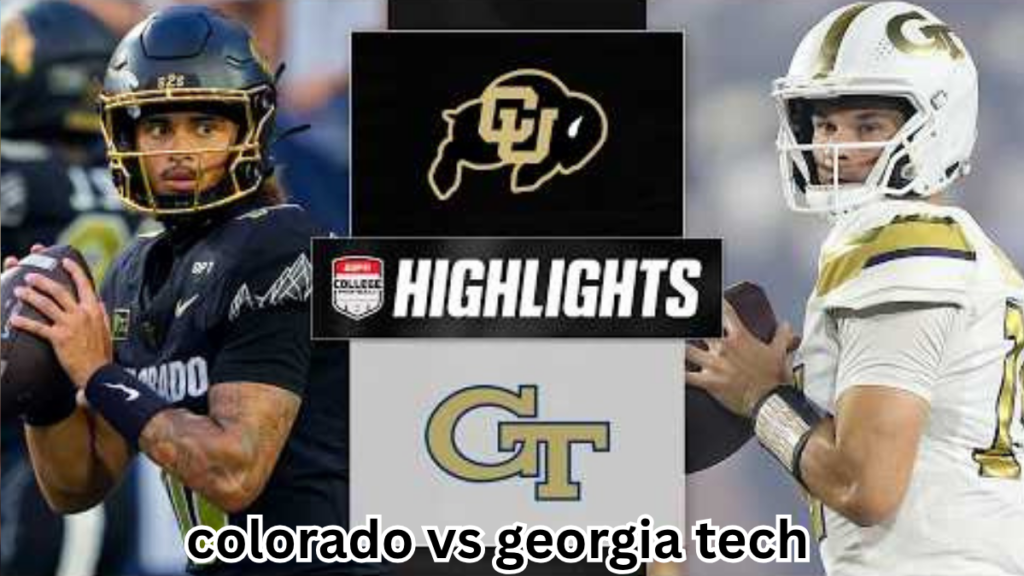
Colorado vs Georgia Tech has quickly become one of the more intriguing nonconference matchups in college football, even though the two programs did not actually play one another until 2025. The reason is unusual: both schools claim a share of the 1990 national championship, yet decades passed before they finally met on the field. That historical coincidence gave the first meeting an immediate storyline, and the two-game home-and-home series has now produced two wildly different but equally memorable contests.
The first meeting, played at Folsom Field in Boulder on August 29, 2025, belonged to Georgia Tech. The Yellow Jackets overcame an early Colorado advantage, leaned heavily on their rushing attack, and won 27-20 behind a spectacular performance from quarterback Haynes King, who rushed for 156 yards and three touchdowns. It was the first game in the history of the programs and immediately gave Georgia Tech a 1-0 series lead.
The return game in Atlanta was completely different. On September 3, 2026, Colorado reversed the result with a dramatic 14-13 victory at Bobby Dodd Stadium at Hyundai Field. The Buffaloes trailed for most of the evening, then scored the go-ahead touchdown with 37 seconds remaining before Boo Carter blocked Aidan Birr’s 45-yard field-goal attempt on the final play. Colorado’s win evened the young series at 1-1.
That second game added another layer to an already unusual football story. The matchup featured two teams undergoing significant changes, two different offensive identities, a new starting quarterback for Georgia Tech, a reworked Colorado roster, and enormous pressure surrounding both programs. It also placed Deion Sanders back in Atlanta, a city deeply connected to his playing career.
The significance of the matchup is therefore larger than a simple win-loss record. It combines national championship history, modern roster construction, coaching philosophies, recruiting, quarterback development, special teams, home-field atmosphere, and the changing landscape of college football.
Why the Matchup Has Such an Unusual History
The historical connection between Colorado and Georgia Tech begins in 1990. That season, Colorado finished 11-1-1 and was recognized as national champion by the Associated Press and several other major selectors. Georgia Tech finished 11-0-1 and won the UPI coaches poll, with the Yellow Jackets edging Colorado by one vote, 847-846. There was no College Football Playoff or national championship game at the time, so the two programs could not settle the disagreement on the field.
The circumstances of that championship race remain fascinating because both teams had legitimate claims. Colorado defeated Notre Dame 10-9 in the Orange Bowl, while Georgia Tech defeated Nebraska 45-21 in the Citrus Bowl. The Buffaloes had the broader support of major selectors, while Georgia Tech’s unbeaten record with one tie and the coaches’ poll victory gave the Yellow Jackets their own historical case.
For 35 years, the programs existed in different football worlds without meeting. The eventual scheduling agreement was therefore more than an ordinary nonconference series. It created the possibility of revisiting a championship debate that had never been settled directly.
Colorado and Georgia Tech announced a home-and-home series in 2016, with the first contest scheduled for Boulder and the return game in Atlanta. The original plan called for the teams to meet at the start of the 2025 and 2026 seasons, making the series one of the more unusual examples of college football history influencing a modern schedule.
The 1990 National Championship Connection
The 1990 season is essential to understanding the larger story. Before the BCS and CFP eras, national championships were determined through polls and selectors rather than a unified championship game. Split titles were therefore possible, and the Colorado-Georgia Tech situation became one of the most famous examples.
Colorado’s season included the controversial Fifth Down Game against Missouri, a victory that remains part of the program’s history. The Buffaloes later defeated Notre Dame in the Orange Bowl, finishing 11-1-1. Georgia Tech, coached by Bobby Ross, finished 11-0-1 and defeated Nebraska decisively in the Citrus Bowl.
The voting was extremely close. Georgia Tech won the UPI coaches poll by one vote, while Colorado received the AP championship. Because there was no mechanism for a championship playoff, neither side could definitively eliminate the other’s claim through direct competition.
That makes the modern series historically unusual. The teams were not traditional rivals in the way that Georgia Tech and Georgia or Colorado and Nebraska were. Instead, their connection came from a single season and an unresolved national championship debate.
When the programs finally met in 2025, that history became part of the marketing and media narrative surrounding the game. The meeting was promoted as a chance to put two programs connected by the 1990 championship on the same field at last.
The First Meeting in Boulder
The first game in the series took place at Folsom Field on August 29, 2025. Georgia Tech entered a hostile environment in Boulder and left with a 27-20 victory, establishing the first head-to-head result between the programs. The Yellow Jackets’ performance was particularly notable because they dealt with early turnovers yet recovered well enough to control the game.
Haynes King was the defining player. His 156 rushing yards and three rushing touchdowns gave Georgia Tech a dimension Colorado struggled to contain. The quarterback’s running ability was especially damaging because it forced Colorado’s defense to account for another threat whenever the pocket collapsed or designed runs developed.
The victory also became an important launching point for Georgia Tech’s 2025 season. The Yellow Jackets ultimately finished 9-4, their highest win total since 2016. Georgia Tech’s own season review described the victory in Boulder as a catalyst for the team’s successful campaign.
Colorado, meanwhile, had to deal with the immediate disappointment of losing its home opener. The defeat was particularly difficult because the Buffaloes had significant national attention under Sanders and were attempting to establish momentum after an eventful previous season.
The 2025 meeting therefore created an interesting setup for the return game. Georgia Tech had proof that its style could work against Colorado, while the Buffaloes had a full year to study what had gone wrong.
What Made the 2025 Game Different
One of the clearest statistical differences between the teams in the 2025 meeting was offensive efficiency. Georgia Tech produced 463 yards of offense compared with Colorado’s 305, according to the historical statistical record for the game. That gap showed how effectively the Yellow Jackets controlled the physical side of the contest.
Georgia Tech’s rushing production was especially important. The Yellow Jackets ran for 320 yards in the season opener, one of their two 300-yard rushing performances during the 2025 season. The ability to establish the run prevented Colorado from simply focusing on the passing game and kept the Buffaloes’ defense on the field.
The game also illustrated the importance of quarterback mobility. King was not merely a passer who occasionally scrambled. His rushing ability became a central part of the offensive attack and created problems for Colorado’s defensive assignments.
For Colorado, the game highlighted the importance of defensive discipline. When an opponent has a quarterback who can turn broken plays into large rushing gains, defenders must maintain gap integrity while also accounting for traditional running backs and receivers.
The 2025 contest ultimately became a blueprint for the type of football Georgia Tech could use to challenge Colorado. It was physical, efficient, and capable of creating explosive plays without relying exclusively on conventional passing production.
The Road to the 2026 Return Game
The second meeting arrived under substantially different circumstances. Colorado was entering its fourth season under Deion Sanders after a difficult 3-9 campaign in 2025. Georgia Tech, meanwhile, was coming off a 9-4 season and preparing to replace both offensive coordinator Buster Faulkner and starting quarterback Haynes King.
Those changes made the rematch difficult to evaluate. Georgia Tech had the advantage of returning from a successful season, but its offense was entering a new phase. Colorado had experienced a disappointing season but had rebuilt significant portions of its roster and coaching structure.
Colorado hired Brennan Marion to lead the offense, bringing a new system built around a high-tempo, physical “Go-Go” approach. The system emphasizes two-running-back sets and a downhill rushing attack, which represented a meaningful change from some of the offensive tendencies associated with earlier Sanders teams.
The Buffaloes also made major roster changes through the transfer portal. Their 2026 roster included a large group of new players, creating both potential and uncertainty. New talent can raise a team’s ceiling, but chemistry and communication often take time to develop.
Georgia Tech faced a different challenge. The Yellow Jackets needed to determine whether they could maintain the physical identity that helped them win in Boulder while adapting to a new quarterback and new offensive leadership.
Colorado’s New Offensive Identity
Colorado’s offensive transformation became one of the most important storylines entering 2026. The Buffaloes wanted to become more physical at the line of scrimmage and establish a rushing attack capable of supporting the passing game.
That approach was put to the test immediately against Georgia Tech. Instead of relying exclusively on explosive passing plays, Colorado repeatedly used its running backs and offensive line to attack the Yellow Jackets.
The results were significant. Colorado finished with 183 rushing yards, its second-highest rushing total during the Sanders era at the time of the game. Four different backs made meaningful contributions, with Damian Henderson II leading the team with 65 yards and Micah Welch adding 58 yards and a touchdown.
JaQuail Smith added 42 yards, while DeKalon Taylor contributed 22 yards and produced a critical 16-yard run during the fourth quarter. The distribution was important because it suggested that Colorado was not dependent on one running back to create its ground production.
The offensive line also received credit for giving the running game enough push to become a genuine part of the game plan. Sanders specifically emphasized that the team’s physical strength up front influenced the decision to continue running the football.
Brennan Marion and the Go-Go Offense
The arrival of Brennan Marion gave Colorado a new offensive identity. His Go-Go offense uses multiple running backs and seeks to create uncertainty for defenses through alignment, tempo, and downhill running.
The system can be particularly useful for a team trying to establish physical credibility. Rather than asking a quarterback to carry the entire offense, it gives the running game a prominent role while still allowing for play-action and passing opportunities.
Against Georgia Tech, Colorado’s system produced a notable change in offensive balance. The Buffaloes were willing to stay committed to the ground game even when the score was not immediately favorable.
That patience mattered. The game remained low-scoring, and every successful run gradually created field position and reduced pressure on the passing attack.
The performance also provided an early indication that Colorado’s new system could produce a more balanced offense. Whether that improvement can continue throughout a Big 12 schedule is a much larger question, but the opening-night evidence was encouraging.
Julian Lewis and the Quarterback Story
Quarterback Julian Lewis entered 2026 with substantial expectations. The young quarterback was expected to play an important role in Colorado’s new offensive structure, particularly because the program had experienced significant changes around him.
Lewis’s challenge was not simply making accurate throws. He needed to manage an unfamiliar roster, operate a new system, and make decisions against a Georgia Tech defense that was prepared for a difficult season opener.
For much of the game, the offense remained constrained. Colorado did not immediately turn the new system into a high-scoring attack, and the Buffaloes had to rely heavily on the defense and rushing game.
The most important moment came late. With Colorado trailing 13-7, Lewis led the Buffaloes on the decisive possession and eventually connected with tight end Charlie Williams for a 20-yard touchdown with 42 seconds remaining. That play gave Colorado the lead for the first time since early in the game.
The drive demonstrated composure. A young quarterback could easily have forced throws in a situation where one mistake would have ended the comeback opportunity. Instead, Colorado sustained the possession long enough to produce the winning touchdown.
That final drive may ultimately become one of the defining early moments of Lewis’s Colorado career.
Georgia Tech’s Quarterback Transition
Georgia Tech entered the rematch without Haynes King, whose 2025 performance had been central to the team’s victory in Boulder. The Yellow Jackets turned to Alberto Mendoza, who was making his first collegiate start.
Mendoza performed well statistically. He completed 17 of 23 passes for 237 yards, demonstrating that Georgia Tech could move the football through the air despite the uncertainty surrounding its new starting quarterback. Wide receiver Jordan Allen was particularly productive, recording eight catches for 113 yards.
Dalen Penson also emerged as an important contributor. After moving from defensive back to wide receiver during the offseason, Penson caught three passes for 73 yards in his first game at the position. His 42-yard reception on Georgia Tech’s final possession placed the Yellow Jackets in position to attempt the winning field goal.
Mendoza’s performance therefore contained both encouragement and frustration. He showed enough passing ability to give Georgia Tech a legitimate chance to win, but the offense struggled to produce touchdowns.
The contrast with the previous year’s game was notable. In 2025, Georgia Tech’s quarterback was the game’s dominant rushing threat. In 2026, the Yellow Jackets relied much more heavily on passing production from their new starter.
The 2026 Game Becomes a Defensive Battle
Unlike the 2025 shootout, the 2026 game became a defensive contest. Colorado’s defense held Georgia Tech to only 13 points, and the Yellow Jackets’ lone touchdown came from special teams rather than the offense.
The Buffaloes recorded three forced fumbles and limited Georgia Tech to 5-of-13 on third-down conversions. Those numbers were crucial because they prevented the Yellow Jackets from consistently extending drives.
The defensive performance was especially impressive considering the amount of roster turnover Colorado had experienced. A new-look defense needs communication and assignment discipline, and the Buffaloes managed to produce both under significant pressure.
Georgia Tech’s offense did move the ball at important moments, but moving the ball is different from finishing drives. Colorado repeatedly forced the Yellow Jackets to settle for limited scoring opportunities.
That distinction ultimately decided the game. A defense does not necessarily need to stop every possession; it needs to prevent enough touchdowns to keep the game within reach.
Lamont Lester Jr. Makes an Immediate Impact
One of Colorado’s most encouraging individual performances came from defensive lineman Lamont Lester Jr. In his NCAA Division I debut, Lester recorded three sacks during the first three quarters.
Colorado’s official account noted that the performance represented the most sacks by a Buffalo in his Division I debut since 2003 and the first time Colorado had recorded that particular feat since 2020.
For a rebuilt defense, an unexpected pass-rushing performance can have enormous value. Pressure disrupts quarterback timing, forces hurried decisions, and makes offensive coordinators adjust their plans.
Lester’s performance also complemented Colorado’s ability to create turnovers. The Buffaloes were not merely surviving Georgia Tech’s offensive possessions; they were actively disrupting them.
The larger significance will become clearer as the season develops. One outstanding debut does not automatically establish a dominant defensive line, but it provides a reason for optimism.
Boo Carter Becomes the Hero
The most memorable player of the night was arguably Boo Carter. The transfer defensive back produced the final play that secured Colorado’s victory, blocking Aidan Birr’s 45-yard field-goal attempt as time expired.
Carter arrived at Colorado after transferring from Tennessee, and his first game for the Buffaloes could hardly have produced a more dramatic ending. The block was not accidental. Carter described his timing as something he had practiced and prepared for, and his positioning allowed him to burst through at exactly the right moment.
The sequence was particularly remarkable because Colorado’s special teams had struggled earlier. Georgia Tech had opened its scoring with a 100-yard kickoff return by Rahkeem Smith, while Georgia Tech had also blocked Colorado’s field-goal attempt earlier in the fourth quarter.
That made Carter’s block a dramatic reversal. The same area of the game that had threatened Colorado’s chances ultimately preserved the victory.
Carter’s performance also showed why special teams remain critical even in an era dominated by offensive statistics. One play can decide a game, and in Atlanta that play happened at the very end.
The Final 60 Seconds
The closing minute of the 2026 game deserves special attention because it contained nearly everything that makes college football unpredictable.
Colorado took a 14-13 lead with 37 seconds remaining. Under normal circumstances, that might have seemed enough to end the game, especially because Georgia Tech had struggled to produce touchdowns.
Instead, the Yellow Jackets responded immediately. Mendoza found Penson for a 42-yard gain on the first snap after Colorado took the lead. That explosive play placed Georgia Tech firmly within field-goal range.
Georgia Tech then prepared Aidan Birr for a 45-yard attempt. Birr was an All-American kicker, making the moment even more significant.
But Carter timed his rush perfectly, got through, and blocked the kick as time expired. The Buffaloes escaped with a one-point victory.
The sequence transformed what had been a controlled defensive game into an instant classic. Both teams had a realistic chance to win during the final minute, and the outcome ultimately depended on two extraordinary plays.
The Importance of Special Teams
Special teams often receive less attention than offense and defense, but the Atlanta game demonstrated their importance in dramatic fashion.
Georgia Tech’s Rahkeem Smith returned a kickoff 100 yards for a touchdown, immediately responding after Colorado had taken its first lead. That return was one of the most explosive plays of the game and gave the Yellow Jackets a major momentum boost.
Later, Georgia Tech blocked Colorado’s 38-yard field-goal attempt. Colorado had put together a 17-play drive, but the possession ended without points because of the block.
Then Colorado returned the favor in the most important possible situation. Carter blocked Georgia Tech’s 45-yard attempt to end the game.
The sequence shows how special teams can dramatically influence close contests. Without the kickoff return, the scoring pattern would have been different. Without the two blocks, the final result might have changed completely.
Deion Sanders Returns to Atlanta
The 2026 matchup had additional personal meaning for Deion Sanders because Atlanta is deeply connected to his playing career.
Sanders played for the Atlanta Falcons from 1989 through 1993 and also played professional baseball for the Atlanta Braves during the early 1990s. Atlanta was therefore a major part of the identity that made Sanders one of the most recognizable athletes in American sports.
The city also witnessed one of the most unusual achievements of his playing career. On October 11, 1992, Sanders became the only athlete to play in both an NFL game and an MLB game on the same day. Colorado’s announcement about the 2026 matchup highlighted that history.
Returning to Atlanta as a college coach therefore created an unusual full-circle moment. Sanders was no longer wearing a Falcons uniform or playing baseball; he was leading Colorado into a nationally televised college football game.
The victory made the return even more memorable. Colorado not only won but did so in a dramatic fashion that gave Sanders another notable Atlanta football memory.
Coach Prime and the Pressure of 2026
Sanders entered 2026 under significant scrutiny. Colorado had gone 3-9 in 2025 after winning nine games in 2024, creating substantial uncertainty around the direction of the program.
Preseason expectations were not especially high. Colorado was projected near the bottom of the Big 12 in some preseason assessments, and the team faced major roster turnover.
That context made the Georgia Tech game more important than a typical season opener. A road victory over a team coming off a nine-win season could immediately change perceptions.
Sanders did not hide the emotional importance of the win. After the game, he emphasized the significance of the result for his players and dismissed concerns about outside criticism. He also described the victory as a major accomplishment for the team.
The win does not erase the challenges facing Colorado, but it provides something the program desperately needed: evidence that its offseason changes can produce results.
Brent Key and Georgia Tech’s Challenge
Georgia Tech head coach Brent Key entered the game with a program that had gained momentum during the previous season. The Yellow Jackets finished 9-4 in 2025, their highest win total since 2016.
That success created expectations. Georgia Tech was no longer simply trying to establish itself as a competitive ACC team; it was trying to build on tangible progress.
The loss to Colorado therefore hurts because the Yellow Jackets appeared to have control late in the game. They led 13-7 with 1:40 remaining and still had a chance to win after Colorado scored its final touchdown.
The response from Mendoza and Penson demonstrated resilience, but the missed opportunity at the end will remain frustrating. A 45-yard field-goal attempt for the win was a favorable situation compared with what could have happened after surrendering the lead.
Georgia Tech now has to separate the emotional disappointment from the larger season. One loss does not erase the progress made in 2025, but it does expose areas that require attention.
What the 2026 Result Says About Colorado
The most important lesson from the game is that Colorado may be capable of winning differently than it did during some earlier stages of the Sanders era.
The Buffaloes did not win because of overwhelming passing production. They won through defense, rushing, situational execution, and a late quarterback-led drive.
The 183 rushing yards were particularly significant because establishing the ground game had been one of the program’s stated goals. The running backs shared the workload, and the offensive line provided enough consistency for Colorado to stay committed to the approach.
The defense was equally important. Holding Georgia Tech’s offense to one touchdown and forcing three fumbles demonstrated a level of physicality that Colorado needed.
That does not mean the Buffaloes have suddenly solved every problem. The season is long, and conference opponents will create different challenges. But the opening performance provides evidence that Colorado’s identity may be changing.
What the Result Says About Georgia Tech
For Georgia Tech, the defeat revealed both strengths and weaknesses. The Yellow Jackets showed that their passing game could function under a new quarterback, with Mendoza completing 17 of 23 passes for 237 yards.
Jordan Allen’s eight catches for 113 yards provided a reliable target, while Penson’s 73 receiving yards demonstrated the potential of his position change.
The concern was the inability to convert offensive possessions into touchdowns. Georgia Tech’s only touchdown came on the kickoff return, while the offense settled for a field goal and ultimately failed to finish the game.
The rushing attack was also less dominant than it had been in Boulder. That difference matters because Georgia Tech’s 2025 victory was built heavily around physical rushing production.
Still, the Yellow Jackets should not interpret the loss as proof that their offense cannot succeed. The passing numbers suggest that Mendoza and his receivers can provide a foundation.
The Role of Returning Production
Returning production is one of the most useful concepts for evaluating college football teams. Continuity can help players understand schemes, communicate effectively, and make decisions more quickly.
Georgia Tech entered 2026 with changes at important offensive positions, including quarterback and offensive coordinator. That meant the Yellow Jackets had to develop new chemistry.
Colorado faced an even more dramatic continuity challenge because of its roster overhaul. A large number of new players can create greater athletic potential while simultaneously increasing the difficulty of building a cohesive team.
The Atlanta game suggested that Colorado’s new players were capable of adapting quickly enough to compete. Defensive communication was strong, and the running back room operated effectively despite being newly constructed.
The challenge is maintaining that level of cohesion over a full season.
Transfer Portal Strategy
The transfer portal has transformed roster construction in college football. Programs can now address multiple weaknesses in a single offseason, but they also face the risk of excessive turnover.
Colorado’s 2026 roster was a clear example. The Buffaloes added dozens of transfers while losing many players from the previous roster. The strategy represented an attempt to reshape the team’s identity quickly.
Boo Carter’s performance showed the potential benefit. A transfer who makes a decisive play in his first game can immediately change a team’s fortunes.
But successful transfer recruitment is about more than individual talent. Coaches need players who fit the system and can build relationships quickly.
The Georgia Tech game suggested that Colorado may have found at least some of that fit. Whether the roster remains cohesive against the demands of Big 12 play will be one of the season’s major storylines.
Recruiting and the Georgia Connection
The 2026 game also carried a recruiting dimension for Colorado. The Buffaloes have developed a strong recruiting presence in Georgia during the Sanders era, and the program’s return to Atlanta provided an opportunity to showcase that connection.
Playing in Georgia can be valuable for a program based in Colorado because the Southeast remains one of the most talent-rich regions in college football.
Sanders’ own history in Atlanta adds credibility when recruiting players from the region. His professional career there provides a personal connection that few coaches can replicate.
A successful road game can strengthen that story. Recruits often pay attention to how programs perform on national television, particularly when the coaching staff can point to a meaningful victory in their home region.
The win therefore had potential value beyond the standings.
National Television and Exposure
The matchup was broadcast nationally on ESPN, continuing Colorado’s unusually strong television presence during the Sanders era. Colorado’s athletic department noted that the Georgia Tech game marked the 24th time in its previous 26 games that the Buffaloes had been selected for ESPN or a major broadcast network, and the 26th consecutive game selected for a national television window when ESPN2 and FS1 were included.
National television creates opportunities for programs to increase visibility among recruits, supporters, alumni, and potential commercial partners.
It also magnifies mistakes. A poor performance is seen by a large audience, while a dramatic victory can become a defining moment.
Colorado received the positive side of that equation in Atlanta. The late touchdown and blocked field goal created highlight material that will likely circulate throughout the season.
For Georgia Tech, the national broadcast provided exposure but also made the late collapse more visible.
Bobby Dodd Stadium Atmosphere
Georgia Tech played the 2026 game in front of a sold-out crowd of 52,113 at Bobby Dodd Stadium at Hyundai Field. It was the Yellow Jackets’ third consecutive sellout, matching their longest sellout streak since 2002.
The atmosphere was particularly meaningful because Georgia Tech had the home-field advantage and entered the game with momentum from its 2025 campaign.
The crowd responded throughout the game, especially when Georgia Tech took control in the fourth quarter. A home team holding a 13-7 lead with 1:40 remaining would normally have a strong chance to close out the victory.
Instead, the final sequence produced one of the most dramatic endings possible.
The atmosphere that had been celebratory became stunned silence when Carter blocked the kick. That contrast is part of what makes home-field football so emotionally powerful.
How the Rivalry Could Develop
The Colorado vs Georgia Tech series currently stands at 1-1 after two games, which means there is not yet enough history to call it a traditional rivalry. The programs have no long-established annual competition, and their geographic separation makes regular meetings unlikely.
Still, the unusual 1990 connection gives the matchup a story that most nonconference series do not possess.
If the teams meet again in the future, the first two games will provide immediate context. Georgia Tech can point to the 27-20 victory in Boulder, while Colorado can point to the 14-13 comeback in Atlanta.
That creates a small but meaningful competitive history. Each program has now won on the other’s home field, making home advantage less definitive in the series.
The next meeting, whenever it occurs, will inevitably be influenced by these two dramatic results.
Comparing the Two Games
The statistical contrast between the games is striking. The 2025 meeting produced 47 total points, while the 2026 meeting produced only 27.
Georgia Tech’s 2025 victory was powered by a huge rushing performance and a mobile quarterback. Colorado’s 2026 victory relied much more heavily on defense and a balanced ground attack.
The first game also featured a stronger offensive rhythm for both teams. In the second, defenses dominated and special teams became central.
This evolution shows how quickly college football matchups can change. The same opponents can produce a completely different game one year later because of personnel changes, coaching changes, injuries, tactical adjustments, and roster turnover.
It also demonstrates why past results should not be treated as guarantees. Georgia Tech won in Boulder in 2025, but that did not automatically translate into victory in Atlanta in 2026.
Key Statistical Comparison
| Category | 2025 Meeting | 2026 Meeting |
|---|---|---|
| Final result | Georgia Tech 27, Colorado 20 | Colorado 14, Georgia Tech 13 |
| Location | Boulder, Colorado | Atlanta, Georgia |
| Series position | Georgia Tech led 1-0 | Series tied 1-1 |
| Colorado rushing | Part of a 305-yard total offense | 183 rushing yards |
| Georgia Tech rushing | 320 yards | More limited than 2025 |
| Key quarterback | Haynes King | Alberto Mendoza / Julian Lewis |
| Major special-teams moment | — | Multiple blocked field goals and 100-yard kickoff return |
| Decisive late play | Georgia Tech controlled the finish | Boo Carter blocked 45-yard FG |
| Attendance | Folsom Field | 52,113, sold out |
The table illustrates why the series is already interesting despite its short history. The two games were decided through very different formulas, demonstrating how coaching adjustments and personnel changes can reshape a matchup.
The 2026 result also gave Colorado its first win in the series and its first game victory in Atlanta against Georgia Tech. The Buffaloes’ official history now lists the series as 1-1, with Colorado holding the most recent win.
Third-Down Efficiency and Winning Football
Third-down performance often provides a useful window into how well a defense is functioning. Colorado held Georgia Tech to 5-of-13 conversions, meaning the Yellow Jackets converted only a little over one-third of their opportunities.
That number mattered because successful third-down conversions extend drives and create additional scoring opportunities. By forcing Georgia Tech off the field, Colorado limited the number of chances the Yellow Jackets had to build a comfortable lead.
For Georgia Tech, the inability to sustain enough drives became costly. The team could move the ball, as shown by Mendoza’s passing numbers, but it struggled to turn possession into touchdowns.
Close games often come down to this distinction. Yardage can tell part of the story, but possession efficiency and scoring conversion frequently determine the final result.
Colorado’s defense performed effectively enough to compensate for an offense that was still learning its new system.

Turnovers and Field Position
Colorado forced three fumbles, another factor that helped keep the game within reach. Turnovers can dramatically change expected scoring because they give an offense possession without requiring it to drive the length of the field.
Although not every turnover resulted in points, the cumulative effect was important. Georgia Tech could not establish consistent control over the game.
Field position also mattered. Colorado’s ground game allowed the Buffaloes to sustain possessions and create manageable situations, while Georgia Tech’s explosive passing plays occasionally changed the field quickly.
The final drive illustrated this perfectly. Penson’s 42-yard reception moved Georgia Tech from its own territory into immediate field-goal range, showing how one explosive play can override several minutes of conservative offense.
The problem for Georgia Tech was that the final field-goal opportunity was blocked.
Why the Running Game Could Be Crucial for Colorado
Colorado’s 183 rushing yards were more than a positive statistic. They represented a potential shift in how the program wants to play football.
A strong running game can protect a young quarterback, control possession, shorten games, and reduce the pressure placed on the defense.
It can also make passing plays more effective because linebackers and safeties must respect the possibility of a run.
The Buffaloes’ decision to use four running backs created depth and reduced the risk of relying too heavily on one player. Henderson, Welch, Smith, and Taylor each contributed in meaningful ways.
Maintaining that balance against stronger defensive fronts will be one of the biggest tests ahead.
Why Georgia Tech Needs Offensive Balance
Georgia Tech’s 2025 success showed the value of a dominant rushing attack, while the 2026 game demonstrated the importance of developing the passing game after a quarterback transition.
Mendoza’s 237 passing yards were encouraging, but the offense needs to turn that yardage into touchdowns.
The best version of Georgia Tech’s offense will likely combine efficient passing with enough rushing production to keep defenses honest.
That balance becomes particularly important in the ACC, where Georgia Tech will face a range of defensive styles and talented opponents.
The Yellow Jackets can take encouragement from their ability to move the ball late. The challenge is making those successful drives finish with points rather than opportunities that disappear.
The Psychological Impact of a One-Point Loss
Losing 14-13 after leading 13-7 inside the final two minutes can be psychologically difficult. Georgia Tech had multiple opportunities to close the game and appeared to have regained control after Colorado’s touchdown.
Yet the nature of the defeat also provides an important lesson. The Yellow Jackets responded quickly after surrendering the lead and created a realistic opportunity to win.
That resilience should matter during the rest of the season. Players and coaches can choose to focus on the collapse or recognize that the team demonstrated enough quality to put itself in position to win.
The difference often comes down to how a team processes adversity.
Colorado, by contrast, gained confidence from surviving a road environment after trailing for most of the game. The victory can strengthen belief in the new system and the rebuilt roster.
The Importance of Close-Game Execution
Close games expose small details. A blocked kick, missed tackle, dropped pass, false start, or poor clock-management decision can have a larger effect than several successful plays.
The 2026 matchup was essentially decided by execution in the final minute.
Colorado executed its touchdown drive. Georgia Tech executed an explosive response. Colorado then executed a field-goal block.
None of those plays can be separated from preparation. Carter’s block, in particular, reflected a practiced technique rather than pure luck. He said the coaching staff had worked on the method and that he had successfully practiced it previously.
That is an important lesson for any football program: dramatic moments are often created through preparation long before they occur.
Coaching Adjustments Between 2025 and 2026
The differences between the two meetings show how coaching staffs can adjust. Colorado’s offensive approach in 2026 was noticeably more committed to the ground game.
Georgia Tech, meanwhile, had to adapt without its previous quarterback and offensive coordinator.
The Yellow Jackets’ passing efficiency suggested that their new structure could work, but the team did not recreate the 2025 rushing dominance that had been so important in Boulder.
Colorado’s defensive changes also mattered. The Buffaloes generated pressure and turnovers while limiting Georgia Tech’s third-down success.
That contrast suggests that both staffs entered the rematch with different priorities, and Colorado’s changes ultimately proved more effective in the final moments.
What the Game Means for the Big 12 and ACC
Although the matchup was nonconference, it had conference implications because each team plays in a different Power Four league. Colorado competes in the Big 12, while Georgia Tech is an ACC member.
Games between major-conference programs provide opportunities to demonstrate how one league’s style compares with another’s.
For Colorado, beating an ACC opponent on the road is useful in the broader perception battle surrounding the Big 12.
For Georgia Tech, the loss is a missed opportunity but not a conference defeat. The Yellow Jackets still have a full ACC schedule ahead and can recover.
The result may therefore matter more psychologically and nationally than it does in the conference standings.
The Road Ahead for Colorado
Colorado’s next challenge is proving that the Georgia Tech victory was the beginning of something rather than an isolated upset.
The Buffaloes have a long Big 12 schedule ahead, including difficult opponents capable of testing the new offense and defense.
The rushing attack will be particularly important. If Colorado can consistently produce around the level it did in Atlanta, the offense will be much harder to defend.
The defense must also maintain its discipline. Three forced fumbles and three sacks from a debuting defensive lineman created an excellent opening-night foundation, but conference play will demand consistency.
The Georgia Tech win provides confidence, but sustained improvement will require repetition.
The Road Ahead for Georgia Tech
Georgia Tech faces its own opportunity to respond quickly. The Yellow Jackets return to Bobby Dodd Stadium for a major matchup with Tennessee, giving the team an immediate chance to recover from the disappointment.
The loss to Colorado does not eliminate the positives from the opener. Mendoza demonstrated passing efficiency, Allen produced a strong receiving performance, and Penson showed that his transition to receiver can create explosive plays.
The main objective will be improving red-zone and touchdown efficiency while finding a way to reestablish the physical rushing identity that characterized the previous season.
Georgia Tech also needs to ensure that the emotional disappointment of losing at the buzzer does not carry into subsequent games.
The Broader Meaning of the Series
The Colorado vs Georgia Tech series is a useful example of how college football history can resurface decades later.
The teams did not need a century-old rivalry to make their games meaningful. The 1990 championship connection provided the initial hook, while the two modern contests created the competitive substance.
The 2025 game established Georgia Tech’s advantage. The 2026 game erased it.
Now the series has an actual sporting history that can exist independently of the 1990 title debate.
That is perhaps the most interesting development. What began as an unusual historical footnote has now become a two-game story featuring a road upset, a comeback, a quarterback transition, a defensive breakout, and a last-second blocked kick.
Players Who Could Shape Future Meetings
Future meetings would likely depend on entirely different rosters, but the current generation has already established several names worth remembering.
For Colorado, Julian Lewis, Boo Carter, Lamont Lester Jr., Damian Henderson II, Micah Welch, JaQuail Smith, DeKalon Taylor, and Charlie Williams all contributed to the 2026 victory in different ways.
For Georgia Tech, Alberto Mendoza, Jordan Allen, Dalen Penson, Justice Haynes, Rahkeem Smith, and Aidan Birr were central to the game.
The list demonstrates how team success is rarely about one star. Colorado’s victory required contributions from the offensive line, running backs, quarterback, defensive front, secondary, and special teams.
Georgia Tech’s near-win required similar cooperation.
The Role of Tight Ends and Short-Yardage Offense
Charlie Williams’ game-winning touchdown highlighted the value of tight ends in a balanced offense. Tight ends can create mismatches against linebackers while also contributing to blocking schemes.
In a system that emphasizes multiple running backs, the tight end can become particularly useful because defenses must account for both run and pass possibilities.
Williams’ touchdown was therefore not simply a lucky connection. It represented the type of play a balanced offense can create when a defense is forced to respect the ground game.
Colorado’s offensive development will depend on continuing to create such opportunities.
The Value of a Physical Offensive Line
A running game cannot succeed without blocking. Colorado’s performance against Georgia Tech suggested that the offensive line was capable of providing the foundation required by Marion’s system.
Sanders explicitly credited the line for moving defenders and said the team’s physical strength up front influenced the decision to stay with the run.
That statement is important because coaches often abandon the running game when the line cannot create movement.
Colorado stayed committed because the line was producing enough success to justify continued attempts.
If that physicality continues, it could become one of the defining characteristics of the 2026 Buffaloes.
The Human Side of College Football
Statistics explain much of a football game, but they cannot fully capture the emotional experience.
Colorado players had gone through a difficult 2025 season. Many new players joined the program in the offseason, and expectations were uncertain.
Georgia Tech players had entered the season expecting to build on a nine-win campaign.
The final seconds therefore meant very different things to the two locker rooms. Colorado celebrated a road victory that could change the mood around its program, while Georgia Tech had to process a loss that appeared to be within reach.
Those emotional differences can influence the trajectory of a season.
Quotes That Capture the Moment
Sanders’ postgame comments reflected his confidence in the team’s preparation. Speaking about the result, he emphasized that the victory mattered to his players and treated it as a meaningful accomplishment rather than simply another game.
His comment after the game that “This is a big win. Period” captured the straightforward significance of the result.
Carter’s description of his final-play technique was similarly revealing. He called the timing “Perfect timing” and explained that he had practiced the method before.
Those comments help explain why the final play was not simply a random football miracle. It was the product of preparation meeting opportunity.
Why Close Games Become Part of Program Identity
Programs often build their identities around memorable moments. A championship is the obvious example, but a dramatic road victory can also become part of a team’s mythology.
Colorado’s 2026 victory has several ingredients that make it memorable: a difficult previous season, a rebuilt roster, a new offense, a road game, a former professional sports star returning to Atlanta, a late touchdown, and a blocked field goal at the buzzer.
Those elements give the game a narrative that can be repeated for years.
Georgia Tech’s 2025 win has its own narrative: the first meeting, Haynes King’s 156 rushing yards, three rushing touchdowns, and a road victory over a nationally visible Colorado team.
Both games now belong to the history of the series.
How the Matchup Reflects Modern College Football
The Colorado vs Georgia Tech story also reflects several major changes in college football.
The transfer portal has become central to roster construction. Colorado’s extensive roster turnover demonstrates how quickly a program can reshape itself.
National television has become essential to program visibility. The matchup was carried on ESPN, putting both teams in front of a broad audience.
Coaching personalities also matter. Sanders brings extraordinary name recognition, while Georgia Tech’s program under Key has developed a reputation for physical competitiveness.
Finally, the absence of long-term continuity between the programs shows how scheduling can create new rivalries rather than relying solely on traditional conference matchups.
What Makes the Matchup Different From a Traditional Rivalry
Traditional rivalries often involve geography, annual scheduling, shared history, and generations of repeated competition.
This series has none of those characteristics to the same degree.
Colorado and Georgia Tech are separated by thousands of miles, belong to different conferences, and had never played before 2025.
Yet they have something equally unusual: a shared national championship controversy from 1990 and two consecutive games with dramatic endings.
That combination gives the matchup its own personality.
It may never become an annual rivalry, but it does not need to. Some football series become memorable precisely because meetings are rare and meaningful.
Lessons for Football Fans
One lesson from the series is that historical narratives can create interest, but the field eventually writes its own story.
The 1990 national championship debate created the initial intrigue. The 2025 and 2026 games then replaced abstract history with actual competition.
Another lesson is that roster turnover can completely alter a matchup. The quarterbacks, offensive systems, defensive personnel, and tactical approaches were substantially different one year later.
A third lesson is that special teams can decide games. Both 2026 teams blocked field goals, and a kickoff return produced a touchdown.
Finally, close games demonstrate why football cannot be reduced to one statistic. Yardage, possession, third-down conversions, turnovers, explosive plays, and situational execution all mattered.
Frequently Asked Questions
What is the current Colorado vs Georgia Tech series record?
The series is tied 1-1 after two meetings. Georgia Tech won the first game 27-20 in Boulder on August 29, 2025, while Colorado won the return meeting 14-13 in Atlanta on September 3, 2026.
When did Colorado and Georgia Tech first play?
The programs first met on August 29, 2025, at Folsom Field in Boulder. Georgia Tech won 27-20 in the opening game of the scheduled home-and-home series.
Why are Colorado and Georgia Tech connected to the 1990 national championship?
Both programs claim a share of the 1990 national championship. Colorado won the AP poll, while Georgia Tech won the UPI coaches poll. Because college football did not have a national championship game at the time, the teams never played one another to settle the disagreement.
Who won the 2026 Colorado vs Georgia Tech game?
Colorado won 14-13 in Atlanta. The Buffaloes scored a go-ahead touchdown with 37 seconds remaining, and Boo Carter then blocked Georgia Tech kicker Aidan Birr’s 45-yard field-goal attempt as time expired.
Who was the hero of the 2026 game?
Boo Carter became the most memorable figure because he blocked the potential game-winning field goal on the final play. He also made the play after transferring to Colorado, making the moment his first game in a Buffaloes uniform.
How did Julian Lewis perform against Georgia Tech?
Lewis led Colorado’s decisive late touchdown drive and connected with tight end Charlie Williams for a 20-yard touchdown with 42 seconds remaining. That score gave Colorado its first lead since early in the game.
How did Alberto Mendoza perform?
Mendoza made his first collegiate start for Georgia Tech and completed 17 of 23 passes for 237 yards. He connected particularly well with Jordan Allen, who recorded eight catches for 113 yards.
What happened in the first meeting?
Georgia Tech defeated Colorado 27-20 in Boulder in 2025. Haynes King was the standout performer, rushing for 156 yards and three touchdowns as Georgia Tech established its physical identity and took a 1-0 series lead.
How many rushing yards did Colorado have in 2026?
Colorado rushed for 183 yards, with Damian Henderson II leading the team with 65 yards, Micah Welch producing 58 yards and a touchdown, JaQuail Smith adding 42 yards, and DeKalon Taylor contributing 22 yards.
Why was the 2026 game important for Deion Sanders?
The game took place in Atlanta, a city strongly associated with Sanders’ professional career with the Atlanta Falcons and Atlanta Braves. Winning there as Colorado’s head coach added another memorable chapter to his long history in the city.
What was Georgia Tech’s biggest problem in the 2026 loss?
The Yellow Jackets moved the football effectively at times but struggled to turn offensive possessions into touchdowns. Their only touchdown came on special teams, while Colorado’s defense held the offense to limited scoring and forced three fumbles.
Does Colorado vs Georgia Tech count as a rivalry?
It is too early to call it a traditional rivalry because the teams have played only twice and do not share a conference or longstanding annual series. However, the 1990 national championship connection and two dramatic modern meetings give the matchup a distinctive historical identity.
Conclusion
Colorado vs Georgia Tech has become an unexpectedly compelling college football story because its significance comes from several different eras at once. The programs were connected by the disputed 1990 national championship long before they ever shared a field. When they finally met in 2025, Georgia Tech won 27-20 behind a powerful rushing performance led by Haynes King. One year later, Colorado returned the favor in spectacular fashion.
The 2026 victory was particularly significant because it demonstrated that Colorado could win through a different formula. The Buffaloes ran for 183 yards, received major contributions from several running backs, pressured the quarterback, forced three fumbles, and held Georgia Tech to 13 points. Most importantly, they remained composed when trailing late.
Julian Lewis delivered the decisive touchdown drive, Charlie Williams finished the possession, and Boo Carter provided the final defensive masterpiece. The sequence transformed a difficult road game into a victory that could have lasting importance for Colorado’s season.
For Georgia Tech, the defeat was painful but not without positives. Alberto Mendoza looked capable in his first start, Jordan Allen emerged as a productive receiver, and Dalen Penson demonstrated the value of his transition to wide receiver. The Yellow Jackets also showed enough resilience to move into field-goal range after surrendering the lead.
The broader story is that these two games have already created a meaningful foundation for future meetings. The series is tied, both teams have won on the other’s home field, and each program owns a memorable chapter. If the schools meet again, the 2025 and 2026 contests will provide immediate historical context.
College football thrives on exactly this kind of unpredictability. A series that began as a decades-old national championship curiosity has now produced a road upset, a quarterback transition, a new offensive philosophy, explosive special-teams plays, and a final-second blocked field goal.
That makes the matchup worth remembering, even if future meetings remain separated by years. The history is unusual, the modern games have been dramatic, and the next chapter will carry the weight of everything that happened before it.